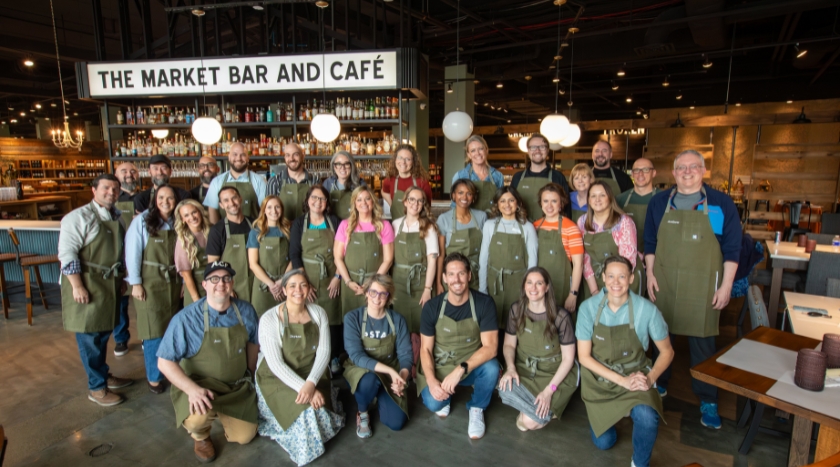
Higher ed marketing can be a lonely profession, particularly the higher up the career ladder you climb — and the more responsibility you take on, generally, the smaller the circle of people who truly relate. If you’re lucky, you’ll have two or three colleagues on campus to bounce ideas off, commiserate with, and lean on, whether they’re fellow marketers or trusted partners from across campus. But a few colleagues, however good, aren’t enough.
We are on the front lines of crises, institutional reputation, enrollment in a shrinking market, executive communications, and too many other battles to name. We need colleagues who have fought these same battles before or are going through them with us right now — and for that, we need to look beyond our own campuses.
So what happens when 30 higher ed marketers stop being overwhelmed and start getting real?
I recently had the pleasure of attending Let’s Go Upstate, a curated professional and wellness retreat for senior higher ed marcomm leaders. Before arriving, I already knew a good portion of the group attending, and I knew I needed to know them. I didn’t know how much I needed to know the other half of the group. I thought my circle was substantial, but what I learned is that my circle should never stop growing.
Over the course of three days in upstate New York, the 30 of us — all sharing a boutique hotel — went from new or casual acquaintances to legitimate friends. Through sound baths and breathwork, pizza-making and breakout sessions, it was as if we had known one another for years. And being the supportive community higher ed marketing is, we all stepped 10 toes into the experience, and to the promise of supporting one another. When I returned to work later that week following the retreat, I felt buoyed by a group of friends — old and new — in the work I’m doing, the decisions I’m making, and my ability to do my job.
In the weeks since, I’ve contemplated what it means to have a community, and why it matters so much for higher education professionals.
Shared Experiences = Shared Bonds
We all have friends or family in our personal lives that we go to when we face a difficulty or challenge. Often, those challenges center on family issues, parenting, or life advice. Few of us have close friends who do the same work we do. That is where the power of the higher ed community fully takes form.
We share a common purpose, and, frankly, common traumas. Our work is parallel; the issues we face every day are common in the rooms we occupy at conferences and retreats. We don’t need to provide a detailed background of the work we do, because we all understand it intimately. That level of established understanding allowed us to form tight bonds and close friendships almost immediately.
We don’t grow in solitude; we grow when we are exposed to people we can lean on in any situation because they’ve been there, done that, and understand exactly what we’re feeling.
What You Know + Who You Know = Career Growth
Being an expert in your field is a must when it comes to advancing your career; there’s no debating that. You can’t fake it to the top, or you will promptly crash and burn.
But who you know is becoming increasingly important. Whether it’s a full-on reference for a position or just someone to go to for advice, your network is an invaluable asset.
Back in 2023, when I was still relatively unknown to most of the higher ed marketing world, Mallory Wilsea — one of the co-founders of Let’s Go Upstate — nominated me for AMA Emerging Marketer of the Year. Even though I didn’t win (totally not bitter at all), simply being nominated changed my profile dramatically, and with it, the course of my career — and my life. Mallory’s willingness to assign her name and reputation to a relatively unknown marketer at a relatively unknown institution is the clearest proof I’ve seen of what a network can actually do.
There are countless other examples of my network in action, and you can see the evidence clear as day any time one of our own announces they’ve lost a job, are seeking a new opportunity, or are going through a challenge. The higher ed marketing community always shows up, and that is one of the true privileges of working in this field.
The More You Know
Yes, having a community certainly helps to boost your morale, helps you feel supported, and crystallizes the value of your industry, but it accomplishes more than that. During the interview process for my current role, I was asked: “What benefits have you seen from hosting a podcast?” It was the first time I had ever been asked that question, which is on brand for the curiosity of W&M staff. My answer was that I now have more than 50 people with whom I’ve spent significant time, who are smarter than me, have varied experiences I don’t, and to whom I can turn when I encounter a problem or situation and need advice or best practices.
Growing your network isn’t just about job references and podcast appearances. It’s about expanding your knowledge base and support system to help you become the best professional you can be. You can’t shortcut experience. But you can borrow it — and that’s what a network really is.
Send the Connection Request
Higher education is an incredibly rewarding career path, though it is not without its significant challenges, like most industries. Having a circle of friends and colleagues to turn to when the going gets tough, catch up with at conferences, and cheer on as they accomplish their goals, enriches the work we do and the value we get out of it. So send the LinkedIn request, send the email, make the phone call, start the conversation, because you never know who you are going to meet that will eventually change your life.