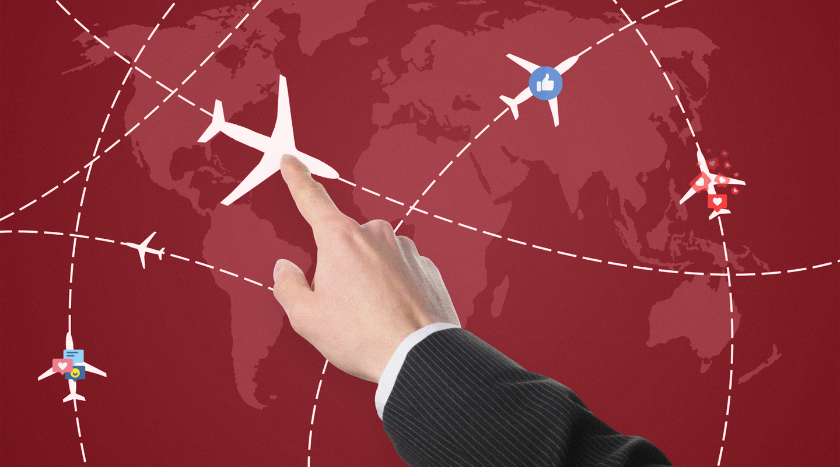
Aviation learned a critical lesson when air travel grew after World War II. As commercial flights multiplied and airspace became crowded, safety and efficiency no longer depended on pilots alone. The work shifted to autonomous systems. When these types of systems scale, the work moves from execution to orchestration. Planes fly themselves; humans manage the airspace.
Media is approaching a similar moment: Platforms increasingly handle delivery, bidding, and optimization, but they can’t decide what success should look like, how channels should work together, or how short-term signals connect to long-term outcomes. That responsibility still sits with people — humans must still manage the balancing act of meeting the demands of media. For higher education marketers, that challenge is compounding. The very audiences institutions most need to reach — teenagers and young adults — are becoming harder to target at scale, as platform privacy restrictions tighten and signal loss accelerates.
The industry is confronting a level of fragmentation, evolution, and interdependence that simply didn’t exist even five years ago. As platforms multiply and automation accelerates, the challenge has quietly shifted from doing the work to making sense of the system.
To see how this shift is playing out in practice, we need to look at the forces pulling planning in different directions — a core set of tensions that now must be managed.
Channel Expansion vs. Cohesion
This is truly an era of abundance. Media has shifted from a manageable channel mix to a sprawling ecosystem spanning CTV, streaming, YouTube, TikTok, podcasts, influencers, retail media, social video, UGC, OOH, and commerce platforms. WARC and IPA TouchPoints show channel fragmentation has increased 60% in the past decade, and planners now regularly manage eight or more channels, each with its own rules, formats, and attention norms.
But more choice doesn’t automatically create more impact. Without a clear understanding of how these channels work together, campaigns expand without becoming more effective. Brands can’t afford disjointed messaging or siloed planning when reach, attention, and attribution are increasingly splintered. The challenge is no longer selecting the right channels — it’s ensuring they add up to something coherent.
Reach vs. Scarcity of Attention
Media supply continues to grow, but meaningful attention does not. Audiences now spend an average of 299 minutes per day with media, including 84 minutes of ad exposure, yet only 9 minutes are actually spent viewing ads. For teens, upwards of 5 hours are being spent with social media per day, with YouTube and TikTok being used “almost constantly.” The gap between what is served and what is seen continues to widen, particularly in environments built around scrolling, skipping, and multitasking.
This creates a fundamental disconnect. Plans can deliver reach on paper while failing to create impact in reality. The implication is clear: exposure alone is no longer a reliable proxy for effectiveness. Planners must consider not just how many impressions are delivered, but whether those impressions are actually noticed, processed, and remembered.
Automation vs. Judgment
Automation now handles much of the execution — delivery, bidding, targeting, pacing, and optimization. Meta estimates that 60% of media spend is already automated, rising to nearly 80% by 2027. But while machines can optimize efficiently, they can only optimize against the signals they are given.
That places a new responsibility on planners. They must define what success looks like, determine which signals matter, and ensure those signals align with real business outcomes — market penetration to application volume in priority geographies. As Meta’s own guidance suggests, the role is shifting from prediction to iteration: machines manage execution, but people set the objectives, constraints, and direction. The better the judgment, the better the system performs.
Paid Media Power vs. Owned & Earned Influence
Paid media still offers scale and control, but it no longer shapes the entire brand experience. Discovery, trust, and decision-making increasingly happen across a wider set of environments — creators, communities, organic social, search behavior, reviews, and brand-owned experiences. Paid media can spark attention, but what happens next — whether someone explores, believes, or acts — is often determined outside of the paid placement.
Yet many organizations still plan these elements separately. The result is a disconnect between what media initiates and what the audience ultimately experiences. Media effectiveness now depends on how well paid, owned, and earned elements reinforce one another. Planners are no longer just designing campaigns; they are shaping how the full brand experience comes together.
Creative Format Needs vs. Platform Creative Realities
Every platform now operates with its own creative logic — its own pacing, storytelling style, visual language, and expectations for engagement. What works on TikTok does not work on YouTube. What performs on Instagram does not translate to CTV. And yet, many creative workflows still assume that a single asset can travel across platforms unchanged.
The evidence increasingly shows the opposite: creative effectiveness depends on how well it fits the environment in which it appears. When creative isn’t built for the platform, media performance suffers — regardless of targeting or budget. This tension forces planners and creative teams to work more closely together, ensuring that what is planned and what is produced are designed as one system, not separate steps.
It’s obvious the role of advertising and media planning is evolving for those within institutions or those supporting institutions. Driven by these core tensions, we can begin to develop a sense – holistically – where the focus should be shifted.
The Shifting Role of the Media Planner
1: Designing Connected Media Systems
Designs how media works together as a connected ecosystem.
The role of the planner, then, is less about control and more about orchestration. It’s about knowing which levers to pull and when to trust the machine. That’s a higher bar than ever, and it demands both data literacy and creative instinct in equal measure.
In practice, this means moving beyond channel-by-channel thinking and designing how everything works together. In higher education, that means building a system that reflects how enrollment decisions are actually made — where early awareness efforts among high school sophomores and juniors eventually connect to retargeting strategies for seniors in active search, and where brand-level media investments reinforce the program-specific campaigns driving inquiry. How paid, owned, and earned reinforce one another. How platforms interact over time. How signals from one channel inform decisions in another. The planner is no longer just assembling a plan — they are shaping a system, one that needs to adapt, learn, and stay coherent as it scales.
2. Aligning Creative with Platform Reality
Ensures creative is built for the environments where it appears.
As attention becomes harder to capture, media and creative can no longer operate as separate disciplines. The effectiveness of a plan now depends as much on how something is made as where it is placed. Each platform comes with its own expectations — pacing, format, tone, and behavior — and creative that doesn’t fit those realities simply may not break through.
This shifts the planner’s role closer to the work itself. It’s not enough to recommend channels; planners must understand how ideas translate within them. For higher ed, that understanding has a specific implication: where authentic student voices and real campus moments may outperform polished institutional creative. What earns attention in a scroll. What holds it. What gets remembered. The job becomes ensuring that media and creative are designed together, so that every placement has the best possible chance to be seen, processed, and acted on.
3. Defining Signals and Guiding Decisions
Sets the signals and rules that automation uses to optimize.
Automation optimizes ruthlessly toward whatever signal you give it. The planner’s job is to make sure it’s the right one.
Automation can optimize at speed, but it cannot decide what matters. That responsibility sits with the planner. In higher education, this is where the stakes are highest: automated systems will chase the signals that are easiest to measure — form fills, clicks, inquiry submissions — and optimize aggressively toward them. But inquiry volume and enrollment quality are not the same thing. It means defining the right signals, aligning them to meaningful outcomes like program-specific growth or geographic expansion, and interpreting what the system returns. Not just reporting on performance, but understanding what it says about audience behavior, creative resonance, and business impact.
The aviation industry didn’t get safer because pilots worked harder and tried to cover more ground. Safer airways evolved because the system built to manage it all got smarter. Automation and human oversight.
Media planning is at that same inflection point. If we’ve argued away the value of the marketing funnel, then these shifts shouldn’t come as a surprise. The opportunity is to replace that model with something more honest: a planning approach built around influence, not simply reach. One that asks not just where a prospective student can be found, but how, and at what moment, a message can actually shape the way they think and feel about an institution. That shift in thinking has a direct impact on how budgets get allocated — moving spend away from high-reach touchpoints that generate impressions but little actual influence, and toward the moments and environments where attention, relevance, and trust converge. In a sense, investing in observable influence is what makes every media dollar defensible.