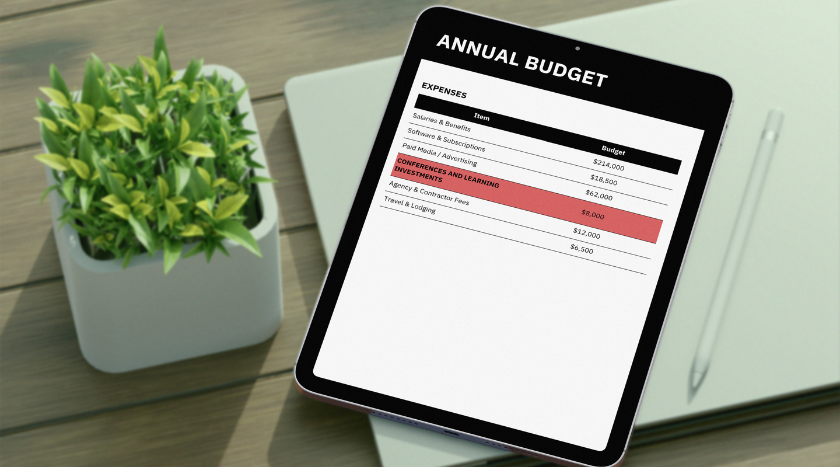
Marketing conferences are a fantastic way to learn about emerging industry trends, new technologies, find actionable tips from industry experts, and network with your peers. Attendees frequently return to the office full of ideas, inspiration, and enhanced skills that can raise the level of work for an entire team. With many great higher ed marketing conferences to choose from, and budgets shrinking, you’ll want to request your conference trip in a way that will be most likely to be approved. Here’s how to do it:
Conference expenses can pile up: the ticket alone typically ranges between $500 and $2,500. Plus, the cost of a hotel is $250 to $400 per night, and because most conferences are multi-day events, that cost easily scales two to four times. Roundtrip flights are $300 – $600, assuming domestic travel. And throw in additional $200 – $400 for meals and taxis to and from the airport. Your total is coming up to $1,500 on the lower end and $5,000 or more on the higher end.
Now, you have 60 seconds to persuade your CFO that attending the conference is the right investment when the budget is tight.
Why this conversation is harder in 2026
More and more institutions are facing budget deficits and it seems like no one is immune. The well-documented enrollment cliff, declining interest from international students, federal research cuts, mismanagement of athletic programs, and inflation are all causing increased financial pressures on institutions.
As a response, universities cut budgets, freeze hiring, limit staff travel, and even eliminate some positions. According to a recent Chronicle of Higher Education piece by Robert Kelchen, communications employees face cuts in 56.4% of cases when an institution is short on funds. While academic departments are more likely to get hit first (in 80.5% of cases), there is a high chance that you will meet skepticism when proposing conference spend without an airtight business case.
How to Approach the Budget Conversation
Here are a few strategies of how to approach the conversation:
The Capability Gap
Don’t pitch the event; pitch the specific operational skills your team currently lacks. Whether it is generative search optimization, advanced data attribution, or AI integration, isolate a clear technical gap.
Show how closing that gap directly serves institutional goals with measurable benchmarks. For example: “By mastering and implementing Answer Engine Optimization (AEO) strategies, we can ensure our programs appear in AI overviews, capturing an estimated X% more high-intent prospective student inquiries.” Finally, prove that an intensive conference is the most cost-effective way to acquire that skill compared to hiring an outside agency/consultant or enrolling in a course.
The Opportunity Cost
Don’t just discuss what going to the conference costs the university — argue what not going will cost. If your team falls six months behind on critical search updates, if your enrollment funnel assumptions remain out of date, or if your primary competitors are adopting operational efficiencies you are blind to, there is a tangible price to pay. The cost of inaction is rarely zero, and it is rarely cheap.
The Team Multiplier
Reframe the ticket from an individual experience into a benefit for the whole team. Make sure you have a plan of how you will share your insights after the conference: Written debrief within a week, internal lunch-and-learn within a month, three tactics tested within the quarter. This converts an individual line item into a team capability investment, which is a different budget category in the CFO’s head.
The Employee Retention
Conferences provide a rare forum to socialize with peers, fight burnout, and remind institutional marketers why their work matters. High turnover is incredibly expensive. Quantify the actual cost of losing a mid-level marketer (accounting for recruitment fees, onboarding ramp time, and lost institutional knowledge) and contrast it directly against the cost of a conference ticket.
The Conversation Itself
After you choose which conference you or someone on your team would like to attend, it’s time to bring your case to the CFO.
Come prepared with the arguments, the research you’ve done and the numbers, but don’t make it into a slide deck, a one-page document is enough. Structure it cleanly: the gap, two capability targets, the proposed investment, and your post-event commitment.
Devin Purgason, Associate Vice President for Student Experience, Marketing and Outreach at Forsyth Technical Community College, sees the value of the conferences in his team coming back smarter than he is.
“When someone spends three days at AMA or EduWeb Summit with peers doing this work at every kind of institution, they come home with a different lens than the one they left with,” says Purgason. “They’ve stress-tested our assumptions against 50 other shops, and the best ideas we ship in the next quarter usually trace back to a side conversation at a hotel bar, not a keynote.”
But expect pushback. An already scarce budget will not be handed over easily. Purgason recommends treating professional development the way he’d ask a vendor to make a case for renewal.
“I show what the team brought back from the last conference and where it lives in our actual work,” Purgason notes. “Not ‘we attended a session,’ but ‘we adopted the AI workflow we picked up at Engage Summit, and it gave the team hours back every week.’
The pitch isn’t that we deserve to go. The pitch is that the last trip paid for itself, and here’s what we’re trying to learn this time.”
Aim for a smaller, defendable number rather than the full team budget. As Purgason puts it: “A vague request for $15,000 in “professional development” is easy to cut. A specific request for one person to attend one conference because we’re trying to solve one problem is much harder to say no to.
Lastly, be ready to name what you’ll cut to fund it. Showing you’ve already done the trade-off math changes the dynamic of the conversation.
“CFOs aren’t villains,” Purgason says. “They’re trying to make sure the money does its work. Show them the work.”