Last year, I printed an email and taped it to my cubicle. It was from an out-of-state student who had never set foot in Iowa, didn’t know a single person here, and wrote to say that our Instagram takeovers made her feel like she could belong. I don’t get emails like that every week. But when they come, they remind me exactly why I do this work, and why it’s worth asking whether the institutions we work for are doing right by the people doing it.
I work as a Communications Specialist at the University of Iowa’s Office of Admissions. I’ve been here long enough to get promoted, long enough to know the rhythms of the academic year, long enough to feel the particular exhaustion that sets in around April. The work can be genuinely meaningful. Jack Olson, a social media coordinator at Iowa’s Office of Strategic Communication, still remembers the early days of his role, when he would text his parents as soon as a post went live. “Hey, this was my idea. I did this. What do you think?” Aubrey Ugorowski, a communication specialist at UW-Madison’s Department of Materials Science and Engineering, lights up describing a faculty calling campaign that people came back from saying exceeded expectations. “Getting to see people’s eyes light up. That’s what I love.”
That joy is real. But it exists alongside pressures that are easier to absorb than articulate: the expectation of being perpetually plugged in, cultural fluency that gets treated as natural rather than earned, and endlessly creative even as enrollment uncertainty makes the stakes feel heavier every cycle. The role looks casual from the outside. It rarely feels that way from the inside. And if institutions want to keep people doing this work, they need to understand what they’re actually asking of us.
The Sector We’re Working In
The context matters. According to Deloitte’s 2026 Higher Education Trends report, roughly 80 nonprofit colleges and universities have shuttered or merged in the past five years, and the nation is projected to see a 13% decline in college enrollment from 2025 through 2041. The institutions still standing are leaning harder than ever on their marketing teams to recruit a shrinking pool of students. Those teams are often staffed by people in their mid-twenties navigating their first real jobs while managing the social media presence of entire universities.
The pressure flows downward.
The Antenna Is Always On
For those of us in social media roles, the invisible labor starts before the workday does. Jack spends around six hours a day on his phone creating, posting, and scheduling content, not passively scrolling. Aubrey has turned off all social media notifications just to keep the lines from dissolving. “Otherwise,” she says, “it really would be 24/7.”
When Miles Kramer, an admissions counselor at the University of Iowa, agreed to do an Instagram Live on our account, he got a small taste of what that means. When I caught up with him later, he mentioned offhandedly that he had stepped away briefly and come back to a phone flooded with notifications. He seemed genuinely surprised. I wasn’t.
Notifications are the visible part. The quieter part is what happens when I’m just scrolling. The difference between consuming content for myself and consuming it for work has mostly dissolved. When I’m scrolling for fun, I’m scrolling for fun. But if I see something useful, I clock it immediately. The consumption is personal. The antenna is always on, whether I choose to switch it on or not.
There’s also an assumption baked into these roles that nobody writes into the job description: that because we’re young, we’re instinctively tuned in to the audiences we’re targeting: prospective 17-year-olds, current students, and recent alumni. Aubrey pushes back on this directly. “My algorithm is so curated to me,” she says. “I am not innately in touch with the prospective student experience just because I’m younger. We could have completely different feeds.” The social listening, monitoring Reddit threads, tracking TikTok conversations about college, and figuring out which trends are worth chasing is actual, deliberate work. It just doesn’t appear in anyone’s job description.
The Thing About Burnout Is That It Keeps Coming Back
Gen Z has surpassed millennials as the most burned-out generation, with 74% experiencing at least moderate levels, according to the 2025 Aflac WorkForces Report. That number doesn’t surprise me. What it doesn’t capture is how the burnout actually feels, not as a dramatic crash, but as a season that keeps returning.
“When I was in college, burnout was presented as this thing that might happen to you ten years into your career,” Aubrey says. “But with our generation, it’s not a big crash. It’s a season that comes and goes. Because even when I love what I do, I get the symptoms every few weeks.”
Jack hit his lowest point not from overwork, but from repeated rejection, a stretch where ideas kept getting shut down, one after another. “That gets super frustrating. Why do I even care to brainstorm new things?” He stopped caring about spelling errors. He stopped caring about posting the wrong things. He came back eventually, but the memory of that indifference is specific and unvarnished.
My own burnout was quieter. Not a crash, not a string of rejected ideas, but a slow erosion from the inside, a shift in the environment I hadn’t asked for and couldn’t control. My output stayed the same. Nobody would have known from the work. But the cost of showing up consistently when the thing that made the work meaningful had changed is its own kind of burnout. You’re not burned out on the job. You’re burned out on holding yourself together inside it.
Aubrey’s version came as a surprise platform launch. In her former role at a different institution, she was handed a brand-new app mid-meeting, no warning, and told she was running it that day. She figured it out and then lived with yet another new channel that never closes. “There’s no way around it. You just gotta get through it.”
The Trust Problem
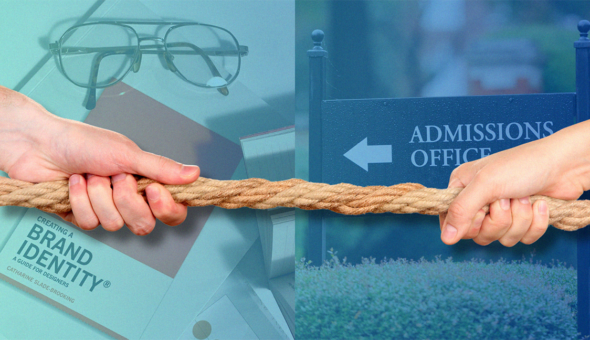
Here’s the tension most people don’t say out loud: You’re hired for your instincts and then asked to prove them over and over again.
“They see the value that we bring to the table because of that age,” Aubrey says. “But at the same time, I do feel that we need to constantly prove our credibility. It’s kind of like this double-edged thing. On the front end: ‘Oh my God, we trust you, you’re so in tune, come to us with ideas.’ And then we do, and they’re like, ‘Oh, but not like that.’”
Jack has felt the same gap from a different angle. He’s watched his own ideas get rejected, then approved weeks later when students pitched the same concepts. His supervisor leads with data. Jack leads with instinct. “Social media is very feel-oriented. You need to go with the flow and capitalize on certain trends, even though it doesn’t always make sense data-wise.” When every idea has to prove itself through metrics, the content that gets made tends to reflect what already worked, which is another way of saying it’s out of date. The data doesn’t exist yet for a trend that hasn’t happened. It still comes down to instinct, and that’s not always something people are willing to trust.
The imposter syndrome compounds it. “It is easy to have imposter syndrome working in social because you get these highest of highs and then you’ll post something two weeks later that does absolutely horribly that you thought was going to do great,” Jack says. “I do need reassurance at some point in my work life to know that I’m still doing what is required of me.”
I feel this too, though it shows up differently for me. Every month, I send a performance report and follow up in my one-on-one when the numbers dip. On the surface, I’m confident. Underneath, I’m quietly questioning my own expertise, because when the algorithm shifts or audience behavior changes, explaining that to someone who doesn’t live in social media every day can feel like making excuses, even when you know it’s true.
That’s the double bind. You’re not trusted enough to lead on instinct, but you’re expected to never get it wrong.
Something Told Me This Should Bother You
The typical career path within a school’s marketing team starts as an entry-level coordinator. Then, after a vast and poorly mapped gap, you become a director. Jack has been a coordinator for four years and found mostly the same thing looking across the university: jobs that either pay less than what he makes now, or demand eight years of experience he doesn’t have yet. “Higher education is not for those looking for more fast-paced, rapid movement,” he says. “It’s too slow-moving.”
Aubrey sees it differently. When asked whether higher ed institutions are set up to retain ambitious young marketers, she doesn’t hesitate. “I think the smart ones are.”
My own path landed somewhere between those two answers. My promotion came three years in, and I had to ask for it. I still couldn’t picture the next rung clearly.
The uncertainty doesn’t always come from inside. It arrives through comparison, through the ambient pressure of a generation that has absorbed rapid upward movement as the only legible form of success. I watched a friend start a role at a private firm, a full year after I started mine, and get promoted within twelve months. Personally, it didn’t bother me. But something told me that this should bother you, the fact that you’re not growing rapidly.
That phrase is a small diagnosis. Not my own dissatisfaction speaking, but the voice our generation has been trained to internalize. And quietly deciding not to listen to it is its own form of resistance, one that higher ed, for all its slowness, occasionally makes possible.
Aubrey notices it starting to change. “I feel a shift happening where a lot of leadership is starting to think, we need to value this perspective, we need to be listening to them,” she says. “Maybe it’s a better late than never situation.”
Five Ways to Help Your Gen Z Team Members
- Ask first. A Gen Z employee is rarely going to be the first one to name a problem. Not because they don’t see it, but because they’re waiting to find out if it’s safe to. “Instead of coming to meetings feeling like you have to have solutions ready, open the dialogue up,” Aubrey says. “Ask: what do you need, how do you prefer to work, what are you looking for. Because at the entry level, those conversations aren’t really happening. Or when they are, it doesn’t really go anywhere.”
- Acknowledge the invisible labor out loud. The social listening, the always-on antenna, the ambient professional expectations that come with being young in this field, none of that shows up in a job description. Naming it matters. It tells your team members that you see the full scope of what they’re carrying, not just what the performance review measures.
- Lead with curiosity before accountability. Algorithm shifts happen. Audience behavior changes. A dip in reach is not always a failure of effort or judgment, and the person closest to the platforms usually knows the difference. Ask what changed in the environment before asking what changed in the work. That reframe costs nothing, and it builds the kind of trust that keeps people in the room.
- Trust instinct before requiring proof of concept. When someone on your team says a trend is worth chasing, ask what they’re seeing before asking for the data. The data doesn’t exist yet for something that hasn’t happened. That’s the whole point. Give the idea a small runway before grounding it.
- Build in the space to be wrong. “We need to give ourselves permission to be wrong more often,” Aubrey says. “There’s a lot of pressure on us to be the subject matter experts, and we’re constantly fighting for that trust. But sometimes we need space to just try and fail.” That means a post that flops gets treated as information, not evidence. That’s the environment where people keep bringing their best ideas instead of protecting themselves from the cost of a bad one.
Higher ed is asking Gen Z marketers to carry something heavy: recruit the next generation of students, speak their language, stay current, stay creative, stay consistent, and do it all inside institutions that are slower than the platforms they’re managing. Most of us are doing it because the work still matters to us. The email on my cubicle is proof of that.
But caring about the work isn’t the same as being seen for it. We were hired to be the voice. We’re still deciding if that’s enough.
This piece is drawn from in-depth interviews with Aubrey Ugorowski, Communication Specialist at UW-Madison’s Department of Materials Science and Engineering, and Jack Olson, Social Media Coordinator at the University of Iowa’s Office of Strategic Communication.