A walk into just about any Power 4 college football stadium on a fall Saturday might feel pretty similar in 2026 to how it felt decades ago. The tens of thousands of fans donning school colors still cheer as loud as ever, while marching bands still blast fight songs to produce a unique sports atmosphere unrivaled anywhere else in the world.
College football and basketball teams serve as marketing powerhouses for their universities, generating a level of organic brand awareness and institutional loyalty that multi-million-dollar paid campaigns simply can’t match. College athletes have evolved from campus figures into powerful brand ambassadors and now earn average social media engagement rates nearly 200% higher than traditional lifestyle influencers. Called the “Flutie Effect” after a game-winning Hail Mary from Boston College quarterback Doug Flutie in 1984 that led to a 30% increase in undergraduate applications the following school year, it allows high-profile athletic success to transform even regional universities into national household brands almost overnight. Statistics show that when a college basketball team makes the NCAA Final Four, undergraduate applications spike at least 4% to 5%. Winning the national championship can drive applications by up to 8%, which makes schools more selective and improves their overall caliber of students.
To be fair, the technology has clearly improved from the past: today’s jumbotron scoreboards dwarf anything that fans in the 1980s probably could have ever imagined. Today’s lightshows after scoring plays can also make many stadiums feel like a giant nightclub at times. But a closer look at the players actually on the field illustrates the greatest shift of all.
Nine of the 12 teams in last season’s College Football Playoff featured a starting quarterback who transferred in from a different school just months earlier. Just about all of those teams also had a star wideout already weighing his options for the coming season. The NIL collectives that now assemble rosters year in and year out operate more like private equity funds than anything resembling university programs.
On the competition field, today’s university sports landscape is unrecognizable from what previous generations came to appreciate about football, basketball and the most popular NCAA sports. And for a while, concerns that fans were quietly souring on college athletics were largely anecdotal: A Reddit thread here, a X/Twitter post there, and water-cooler chatter.
Now the data is beginning to catch up, and for university marketing directors, the numbers offer a real challenge.
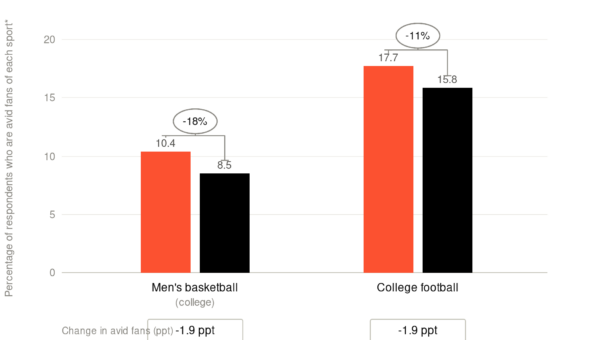
The 2025 Sports Survey, an annual report from global strategy consulting firm L.E.K. Consulting, found college football and men’s basketball suffered the largest year-over-year decreases in avid fandom among nearly two dozen university and pro sports leagues. According to the survey, men’s college basketball suffered an 18% drop from 2024 to 2025, while college football saw an 11% decline. In other words, millions of combined fans, in the span of one year, stopped considering themselves devoted followers of the two major sports that have long served as universities’ most visible brand assets.
Likewise, an October 2025 poll from market research giant Ipsos found that while most Americans still support players earning money through NIL, a growing percentage believe major college sports have become too exclusively about money-making. They worry the tradition and pageantry that made college sports culturally distinct are eroding, according to Ipsos researcher Johnny Sawyer.
“We see it mostly from Baby Boomers, Gen X and some Millennials,” said Sawyer, who co-authored the report. “Gen Z is less likely to hold that belief. But fan skepticism, and a degree of fatigue as a whole, is undeniably growing.”
Scholar Says Disassociation is “Erosion,” but Not a Tipping Point
Michael Lewis, a longtime marketing professor at Emory University who specializes in fan analytics, was quick to reject the idea of some dramatic break point on the horizon. Lewis argues the risk of professionalizing college sports is more subtle, yet harder to reverse.
“I think the danger is more like erosion, like this slow, gradual erosion,” Lewis said. “We intuitively think something going wrong is going to harm the fandom, but we’ve got other things going on that camouflage it.”
He acknowledged the viewership metrics, which despite controversial changes to the Nielsen ratings system, suggest college football and basketball fans are still watching games at record numbers. But behind the juiced-up metrics, Lewis believes the connective tissue between fan and team is slowly degrading. An avid basketball fan, he pointed to watching a Power 4 conference game at the start of the season as a prime example.
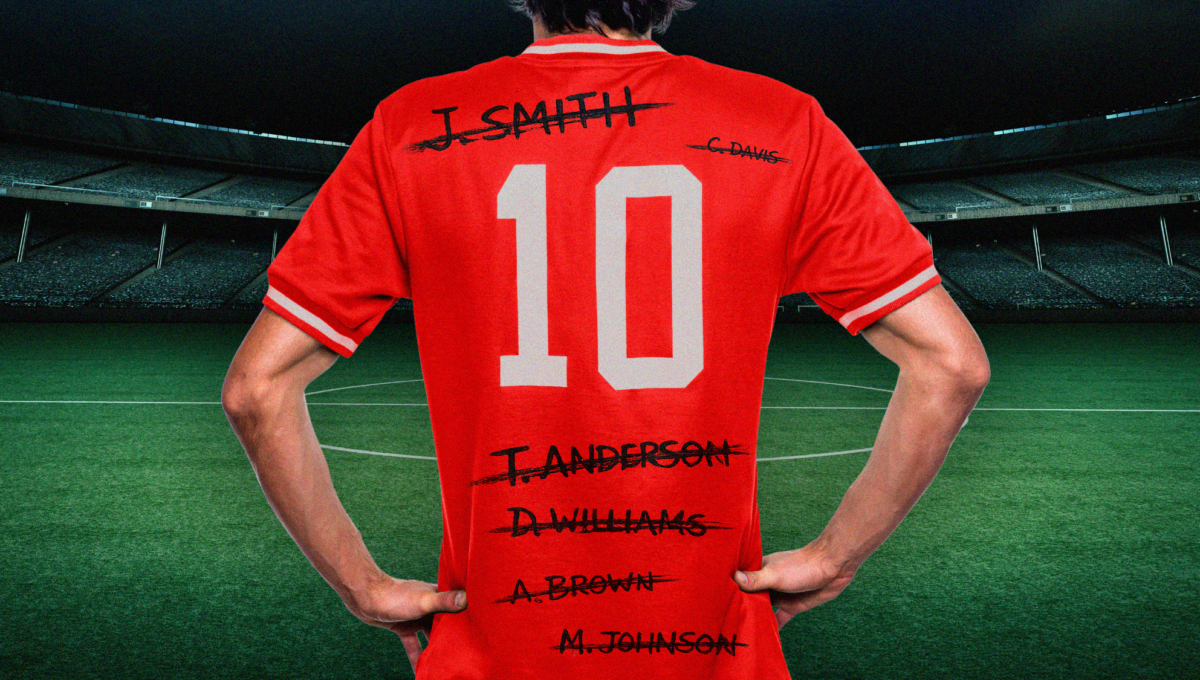
“Every year now, it’s almost like: tune in on November 1st and see the 10 new guys playing for Illinois. As a fan, you don’t have the memory of any of these guys playing for four years and you don’t have that fan-athlete relationship built up over time.”
The comparison he finds most apt comes from finance. College football, Lewis noted, has over 130 years of accumulated brand equity, with generations of alumni who bled school colors and had “lifelong Buckeye” or “diehard Volunteer” included in their obituaries. That equity is now being drawn out as the pay-for-play era gives disproportionate power to athletes.
“The current players are the biggest winners in all of this,” he said. “They’re harvesting that brand equity that these schools and these previous generations of players created. And it’s similar to other private equity stories: they harvest the equity in the brand and then move on.
“I wouldn’t go as far to say we’ve reached a tipping point, but the question marketers have to ask is how do we keep alumni and fans connected when college sports has become so transactional?”
Some Fans Choose Institution Over Players
Charles Clotfelter, professor emeritus of public policy at Duke University and author of Big-Time Sports in American Universities, has spent decades studying the “curiously durable” relationship between fans and institutions. Per Clotfelter, the average person’s loyalty to a university sports team often has nothing to do with the players themselves. He still regularly stops strangers wearing Duke apparel in public just to ask them why they care.
Clotfelter’s experience points to the bonds being more institutional than personal. He says for marketers, that fact can be either reassuring or alarming depending on how you frame it.
“I haven’t found any evidence that all of this new commercialization has affected people’s enthusiasm,” Clotfelter said. “As long as they don’t change the colors and the mascot, I’ll know who to cheer for.”
But Clotfelter also acknowledges the structural shift that Lewis identified. The transfer portal, plus the countless college basketball players who leave for the NBA after just one season, means fewer college fans can enjoy four years of following a player. Even at the professional level, multi-year contracts allow fans to build more genuine attachments to individual players.
“That’s not really happening in major college sports anymore,” he admitted.
What’s Actually at Stake for Marketers and Universities
If Clotfelter’s theory is true, that fans’ emotional connection to an institution’s colors and uniform rather than the players, the question for university marketers becomes: what happens when even that association starts crumbling?
It’s a fair question given the history to back up Clotfelter’s claim. The “Flutie Effect,” named after Boston College quarterback Doug Flutie’s 1984 Hail Mary to beat Miami, led to a 30% application spike that followed over the next two years. More recently, the University of Colorado saw a 20% uptick during the 2024 application cycle, which coincided with NFL legend Deion Sanders’ first season as the school’s head football coach.
The marketing firm SimpsonScarborough offers one of the clearest roadmaps forward. Its report on how last year’s House v. NCAA settlement can reshape higher-ed brand strategy, frames the current landscape as one of simultaneous opportunity and peril. Student-athletes, the firm noted, are now “high-profile contributors to institutional visibility, with personal platforms and audiences of their own.”
But that cuts both ways. Schools that fail to integrate their athletics brand with their broader institutional story risk watching those platforms work too much for the athlete’s personal brand rather than the university’s.
The forces accelerating the disconnect are only getting stronger. The NIL economy across all of college sports now totals some $2.7 billion. And since last June’s House v. NCAA settlement, schools can share $20.5 million directly with athletes each year, essentially formalizing the professionalism of college sports in everything but name.
The trickiest part, according to both Lewis and Clotfelter, is that the paradigm shift isn’t showing up in plain sight. Stadiums are still filling up, viewership ratings are still growing, and donations to athletic programs are still pouring in, at least for now.. The lag between cause and effect in something as deeply socialized as sports fandom can extend for years, even decades.
“We see the tip of the iceberg,” Lewis said. “The core traditional college fandom is taking some hits. But we’re certainly moving to something different.”
For university CMOs, the structure in place means teams on the field are no longer building university brands like they once did by default. That work now moves to marketing: connecting a roster of mercenary talent to an institution with a 150-year history through storytelling, intentionally aligning athletic programs and the university’s academic brand. The schools that treat that as a marketing necessity are the ones whose brands will survive the transition.