Every higher-ed CMO is dealing with the modern challenges of recruiting traditional students — decreased demand, lower trust, shifting digital behaviors, and skepticism over the value of a degree. A common thread among them is that the cycle for introducing high-schoolers to universities now regularly happens too late. Would-be students are overwhelmed by marketing noise, mostly digital, while traditional marketing tactics just don’t yield the same returns as years past.
Simply reaching students before their junior year of high school has become an expensive, uphill battle. But there’s good news: for many schools, a multi-million-dollar brand awareness campaign runs every Saturday during the Fall and three times a week during the winter months into early Spring. The campaigns aren’t happening through marketing departments; they’re taking place on football fields and basketball courts.
Research shows that success on the football field contributes to undergraduate applications surging by an average of over 17 percent from one year to the next. Per consultancy IvyWise, a university would have to lower its tuition by nearly 4 percent or enact a massive hiring spree of world-class faculty to achieve that same 17% boost in applications without a winning sports team.
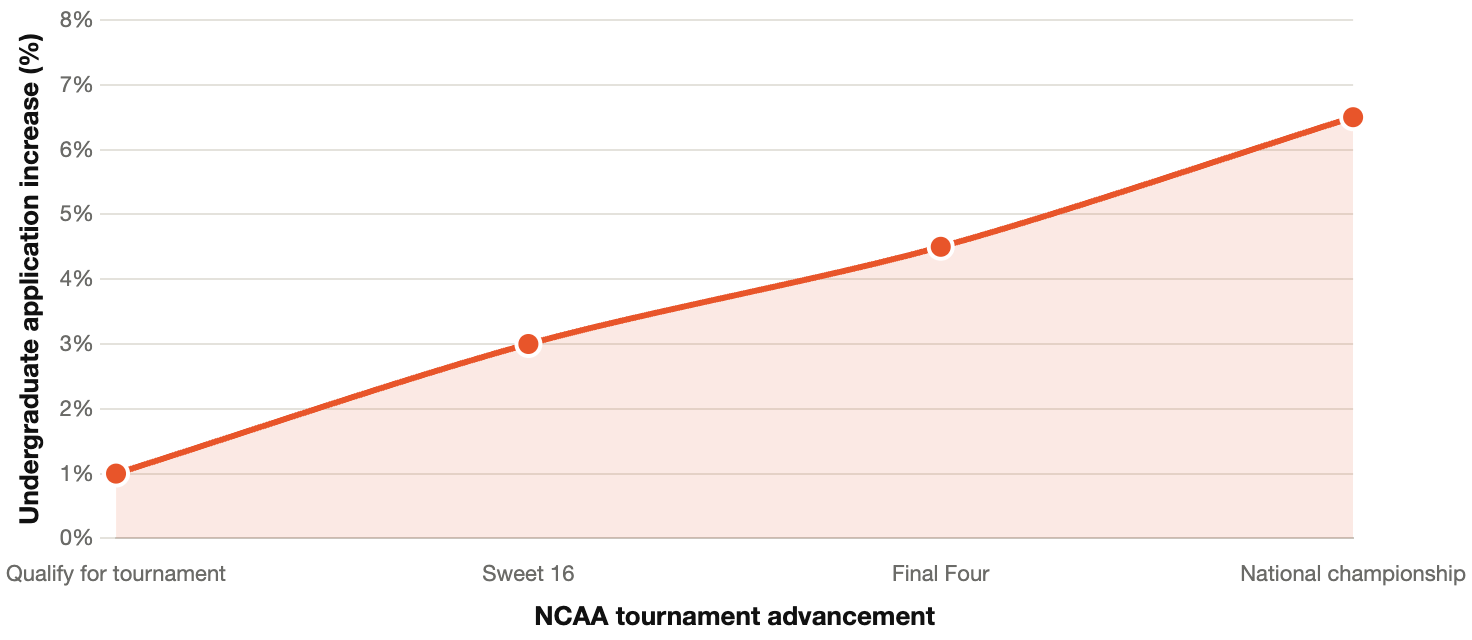
In Division I men’s college basketball, simply qualifying for the NCAA tournament increases undergrad applications by 1%, while reaching the Sweet 16 contributes to an estimated 3% increase. Making the Final Four leads to an average 4% to 5% bump while winning the national championship contributes to a 6% to 7% increase.
“What makes the marketing power of sports so uniquely potent compared to a standard billboard or commercial is the intense emotional equity embedded within it,” explained Doug Chung, marketing professor at the University of Texas. “When kids see a campus erupting in celebration, they’re likely to see a place where they want to learn and belong.”
Ask children to identify different universities, and it will be immediately clear which of them are sports fans. A child who spends Saturdays watching football will rattle off a dozen schools, like Alabama, Oregon, Michigan, and Texas, without hesitating. Not because they have ever researched the schools, but because the universities’ names and colors showed up on their screens. More importantly, the exposure of the schools was attached to a fun, exciting and community-inspiring subject in sports.
Chung said in an interview with Volt that teens who don’t watch sports, or perhaps aren’t as big of a fan, usually can’t keep pace. Even when teens are living in the same household with essentially the same upbringing, a young college sports fan will almost always have significantly greater awareness of higher education’s biggest brands. Marketers have been trying to grasp this trend for years, but one thing is clear: in a media environment where traditional advertising isn’t keeping up, college athletics could be higher education’s single most effective engine for promoting university brands.
The Cost of a Shorter Lifecycle
According to the PEER Center, higher-ed ad spending fell from $1.26 billion in 2010 to roughly $600 million in 2022, with institutions abandoning broad brand-awareness campaigns in favor of hyper-targeted, short-term performance marketing like paid search and social.
Per Chung, this pivot prioritizes “demand capture” over “demand creation,” which assumes prospective students are actively searching for schools. But in higher ed’s low-frequency, high-consideration space, prospective students start forming opinions years before they ever touch an application. As Volt contributor Chris Huebner recently noted, “If a brand is not already on that shortlist, winning the decision becomes significantly harder — and more expensive.”
That’s where college sports steps in as a living room billboard. When a child recognizes a university on television years before they ever take the ACT, the school is executing what legendary statistician Andrew Ehrenberg’s “Weak Theory of Advertising” calls a “nudge,” building subconscious memories that grow over time.
“Athletics are a front door for institutions in how they can generate broad, emotional brand equity long before a student enters the traditional enrollment funnel,” Chung said. “When a school cuts its traditional brand advertising, athletics often become their principal advertising.”
An Undeniable Impact
Chung, who taught at Harvard Business School for 10 years before moving to Texas in 2022, has studied sports’ impact in university marketing extensively. His 2013 paper on college sports’ impact on university advertising remains a leading source of research for higher-ed marketers and university CMOs across the country. In it, Chung discovered that glorious moments on the gridiron and hardwood can help application numbers skyrocket.
Take the “Flutie Effect,” where applications at Boston College spiked 30% in the two years after quarterback Doug Flutie defeated rival Miami on a last-second Hail Mary touchdown in 1984. Around the same time, Georgetown University saw its applications climb 45% as Patrick Ewing led the school’s men’s basketball team to three deep runs in the NCAA Tournament. Likewise, Butler University’s appearances in the 2010 and 2011 NCAA Tournament championship game resulted in a 40% applicant spike.
More recently, University of Colorado’s 2022 hiring of Deion Sanders led to a 20% spike in undergraduate applications the following year, while Florida Atlantic’s underdog run to the 2023 Final Four led to 14% more prospective students applying.
“It’s undeniable,” Chung said. “When a university’s sports teams perform well, especially in the most popular and visible sports, it brings more positive publicity and exposure to the institution itself.”
Chung and Davidson were clear that the statistics don’t mean athletic departments should be running marketing for admissions. But it does suggest many CMOs have incredibly valuable, and perhaps underused, assets in their university athletic departments. It’s an emotional engagement machine that’s already humming, often without coordinated messaging behind it.
Davidson said institutions can leverage real value out of their sports teams by coordinating the messaging beforehand: treating big moments on the gridiron, hardwood, and elsewhere as marketing inflection points. Instead of reacting only after huge successes, schools should have creative narratives ready in advance.
There’s also a long-term element to it all. Per Davidson, if brand awareness increasingly needs to start before students even reach high school, then young people absorbing a university’s name and colors through years of Fall football and Winter hoops could represent some of the cheapest, longest-running impressions in the entire enrollment funnel.
“The kid who can already name your school at age 10 isn’t a lead yet,” she said. “But that kid is a lot closer to becoming a lead than one who’s never heard of you at all.”
How a Marketer Can Leverage Their School’s Sports Team
Successful marketers, to the extent possible, will jump ahead of their school’s athletics success with prepared angles to leverage it, explained Katlin Swisher, director of strategy planning at higher-ed marketing firm SimpsonScarborough. By predicting glorious sports moments ahead of time instead of treating them as lucky bursts of attention, marketers can have win-trigger creative kits built out and approved in advance. That means ad templates, social assets, short-form video, landing pages, student-life messaging and admissions plugs should be ready before the final buzzer or whistle.
Having marketing kits built in advance allows universities to fully capitalize in the moment of a sporting success instead of waiting hours or days for approval across different departments. Not being ready, Swisher said, means marketers could miss out on important momentum.
“Speed matters because athletic attention is often emotional, fleeting and geographically concentrated,” she said. “A big upset, an unexpected run to a bowl game or through the NCAA Tournament can turn a school into a household name for a night. Especially through the broadcast, where high-school students and parents just spent several hours listening to the fight song and watching the student section on their screens.”
The next step is for marketing and athletics to coordinate around those TV and streaming markets, then retarget key DMAs with paid social, YouTube, connected TV and search within 24 to 48 hours of the big sports moments. The creative doesn’t need to hard-sell admissions, it can connect the energy of the moment to campus pride and making students feel they belong.
Outside of big moments on the field and court, more tangible opportunities to generate leads are hiding inside athletic departments, Swisher said, especially through camps and clinics. A soccer clinic, basketball camp or football prospect day can attract middle-school and high-school students to campus with their parents years before they might schedule an admissions tour. For marketers, camps and clinics aren’t merely athletic programs, but friendly brand encounters where schools can start lasting relationships with students and their families.
Per Swisher, athletics isn’t a replacement for admissions marketing. The two should just always be intertwined to a certain degree. Memorable sports moments spike viewer awareness for a university brand, while also providing emotional memories that many paid campaigns would struggle to generate on their own. When marketing teams prepare in advance, move quickly after big moments and use hands-on athletic events like camps and clinics to build real leads, they turn the living room billboard into something closer to a working front door.
“It doesn’t mean university athletic departments need to start reporting to marketing offices,” Swisher said. “It just means marketing should treat athletics departments the same way it would any other high-performing channel. They need to have a plan ready before the inventory shows up.”