
Cereal.
America’s favorite breakfast should be in contention for the consumer good that has been used to shed light on the mechanics of advertising.
From Erwin Ephron: Advertising didn’t sell more cereal. The empty box did.
From W.K. Kellog: To build production facilities (for his cornflakes), X million dollars; to get consumer acceptance, three times as much.
Two quotes. One uncomfortable truth: getting people to recognize, consider, and choose you is harder than reminding them you exist after the box is empty. And it costs more than most people plan for. Category research gives us some insight into why— starting with what markets actually do.
Market Stationarity
In a study covering 639 brands across 28 categories over five years, researchers Trinh and Anesbury found that only 14% of brands changed their market share by more than three percentage points. Short-term gains occurred but competitors responded, markets rebalanced, and share reverted back to the longer-term patter. What this indicates is that in a stationary market, advertising’s primary job isn’t to grow share. It’s to hold it. Or create a competitive moat.
Undergraduate recruitment fits this description closely. Consideration sets form through years of accumulated signals — visits, reputation, word of mouth, proximity — not always through a single campaign. Meaningful shifts tend to be driven by something structural. Rarely by advertising alone.
Structural Variation Within A Stationary Market
Beneath the stationarity headline, Trinh and Anesbury found variation ranging from 0% to 44% of brands experiencing meaningful share shifts. What drove that variation wasn’t advertising spend. It was structural: categories with lower penetration and lower purchase frequency showed dramatically more brand growth and decline.
The California State University system makes this visible. Through pandemic swings, recovery, and growth, a consistent share of new student recruitment remained consistent.
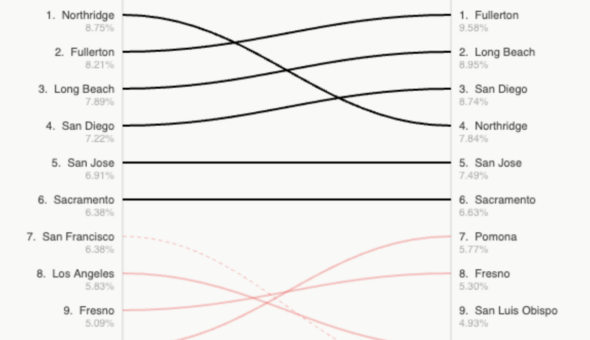
That’s not a reason to stop investing. It simply provides a new lens to determine advertising’s role in the marketing mix.
Calibrating Spend to Market Conditions
Once you’ve accepted the structural diagnosis, the work of John Philip Jones’s share of voice versus share of market framework becomes a genuinely useful planning tool.
Jones found, across over 1,000 advertised brands, that large established brands can sustain their market position with a share of voice below their share of market–an advertising economy of scale earned through years of brand building. Smaller brands, by contrast, typically need to overinvest in share of voice just to maintain relevance.
In undergraduate recruitment, this plays out in a recognizable way. Institutions with deep regional roots, generations of alumni, and accumulated reputation have effectively pre-funded a portion of their consideration set presence. Their advertising works harder because the brand is already doing significant work before a dollar is spent.
The Law of Double Jeopardy explains this. Larger brands accrue compounding advantages simply by virtue of their market position — more buyers, and more loyal ones, more word-of-mouth and elevated performance metrics. Without this ‘structural’ support, those in a weaker market position must ask for the same consideration as asking a prospect to do more cognitive work with less prior scaffolding.
For institutions without that foundation, the same dollar in the same channel doesn’t produce the same result. Jones’s framework suggests two honest choices: invest above your current share of market in channels where you’re genuinely building brand connection, or find the sub-markets — the lower-penetration audiences and geographies — where your share of voice can be proportionally more powerful. Higher investment in brand connection upstream leads to higher quality returns downstream. The math works. But only if the investment is made intentionally, not by default.
A Framework for Planning
Kellogg was right that consumer acceptance is the harder investment. What category research adds to that insight is this: the conditions under which you’re seeking that acceptance matter enormously. A stationary market with high penetration rewards patience and consistency. A dynamic market with low penetration rewards boldness and presence. Knowing which one you’re in — and calibrating your spend accordingly — is the difference between a media plan that holds ground and one that actually gains it.
Here’s how that diagnosis might look:
| Cluster 1: Where You Stand in the Market How has your enrollment share moved over the last five years relative to your closest competitors — held steady, drifted, or shifted? Is your enrollment growth tracking regional demographic trends, or diverging from them? Growth that mirrors population trends isn’t market share growth. Have any structural changes — a new competitor, a program launch, a regional employer shift — meaningfully altered your competitive set? | Cluster 2: How Deep Your Brand Already Reaches Can high school counselors in your primary feeder markets name you without prompting? What does your yield rate tell you by geography? Strong yield signals brand conviction. Weak yield despite strong applications signals awareness without trust. Are there markets where you’ve never actively advertised but consistently enroll students? | Cluster 3: What Your Advertising Is Actually Doing Do you know your share of voice relative to your three closest competitors? If not, that’s the first thing to find out. Is your channel mix building broad awareness or concentrated in performance channels that only reach people already considering you? When you’ve reduced spend in past cycles, what happened to enrollment one to two years later? |
| Clusters pointing toward stability and depth call for consistency. Meaning protect your share of voice and reinforce existing associations. Clusters revealing vulnerability call for boldness. Overinvest where brand associations form earliest, and find the sub-markets where your voice can be proportionally louder. | ||
For any of us marketing institutions of higher education, getting into the consideration set is the job. How you fund that job, and whether you understand the structural conditions you’re working within, is what separates institutions that spend efficiently from those that just spend.