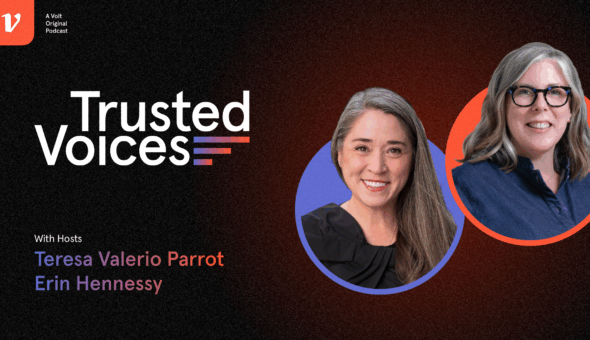
In this episode of Trusted Voices, Anne Harris, president of Grinnell College, joins Teresa and Erin to offer a grounded but forward-looking perspective on what it means to lead a college right now.
Harris says that the political volatility, shifting public trust, and increased scrutiny facing higher education aren’t abstract challenges, they’re daily realities, and reframes them from being existential threats to a call to engage more intentionally.
At the center of that engagement is relationship-building. Harris emphasizes that government relations aren’t just about advocacy at the highest levels. They’re about sustained, local connections with policymakers, communities, and stakeholders who shape how institutions are understood and supported. For private colleges especially, that proximity matters.
But leadership, in her view, isn’t just external. It’s cultural.
Harris says critique is a good thing. Not as conflict, but as a necessary ingredient for growth. Creating environments where questioning is encouraged, where ideas are tested, and where students and faculty feel empowered to challenge assumptions is core to the academic mission.
And yet, amid all the complexity, one theme cuts through: joy. Even as institutions navigate financial pressures and political headwinds, they must remain places where students feel inspired, connected, and energized by learning.
Show Notes
- 2 Accreditors Say They Paused DEI Standards. That’s not Enough for Trump’s Ed Department
- 2026 Survey of College and University Presidents
- Sian Beilock’s Star Turn
- What Will It Take to Address the Pell Shortfall
- Student Press Report
- The President’s Bookshelf
- The Unmaking of the American University
- The Everlasting
- The Pretender
Read the full transcript here
Teresa Valerio Parrot
Hello and welcome to the Trusted Voices Podcast. I’m Teresa Valerio Parrot, alongside Erin Hennessy, and in each episode we discuss the latest news and biggest issues facing higher education leaders through a communications lens. For these conversations, we’re often joined by a guest who shares their own experiences and perspectives. But we also make time for one-on-one conversations about what we’re seeing, hearing, and thinking.
Trusted Voices is produced by Volt, the go-to news source for higher education leaders and decision makers. Remember to visit Volt at voltedu.com and Subscribe to Trusted Voices on Apple Podcasts, Spotify, YouTube, or wherever you get your podcasts to make sure you never miss an episode.
Erin Hennessy
Hello, Teresa.
Teresa Valerio Parrot
Hello, it feels like forever since we have been podcasting together.
Erin Hennessy
True, and yet not forever. Just, just a little brief time. It is amazing that we are able to figure out a time to actually be together because we are deep in conference season. Last time we chatted, not forever ago, just a couple of weeks, I was in the middle of the ACE annual meeting. There’s no need to rehash all of it. I think people probably read about Under Secretary Nicholas Kent’s remarks at the meeting, which were brazen to say the least, and yee-hoo, they were noteworthy.
Teresa Valerio Parrot
Yes, they were noteworthy. Yeah.
Erin Hennessy
They were noteworthy.
Teresa Valerio Parrot
And I journeyed to Atlanta. Yeah.
Erin Hennessy
You did. Hotlanta, as the kids call it.
Teresa Valerio Parrot
You know, it wasn’t that hot. It was very rainy, but I was there for the Public Relations Society of America’s Counselors to Higher Ed meeting. And it was my great honor to present the Pat Jackson Award to Ken Carter. And most importantly, I was able to catch up with a number of colleagues and see people that you and I both know and adore and hear people talk about their great work in the comm space. So to everybody I got to see in Atlanta, thank you.
Erin Hennessy
And I am headed out next week to AGB’s National Conference on Trusteeship, which is in your backyard. Thank you so much for hosting that conference in your backyard.
Teresa Valerio Parrot
Thank you, yes, we are excited. Kevin is going to be doing some yard work.
Erin Hennessy
Yes, I’m very excited to see folks talk about the big pressing issues. As we always say, governance is everywhere right now. And so it looks like a lot of people want to come talk about it in Denver. So I will have more to share about that soon. Next time.
Teresa Valerio Parrot
Excellent. Next time we can talk about where we’ve been since we talked.
Erin Hennessy
Yeah. What else do you want to talk about? Because I know we are both very excited about the conversation we are having today, so I don’t want to spend too much time on our yammer.
Teresa Valerio Parrot
Yeah, I’m going to give us a quick look back. Very quick. One, last time I mentioned a documentary film that I went to see and I mentioned Cesar Chavez. And I would be remiss if I didn’t also follow up and say since then, there have been allegations of grooming and sexual abuse that had been levied against him. They were outlined in the New York Times. And we’ve also talked about Epstein on this podcast.
So just wanted to circle back and say that I am pleased to see how fast, when people want to move fast, they can make decisions not to honor those who perhaps we did not fully understand their history and their impact in other ways. So I just wanted to bring that full circle because I had mentioned him on the last podcast and that is a significant change. So that’s one.
The second is, I want to go back to an episode that we had just over a year ago where we had Belle Wheelan on, and she was talking about the future of accreditation. I would encourage everybody to read an article that was in the Chronicle from Sophia Bailey. talked about how the Trump administration is pushing accreditors even further to remove DEI standards and references. So if you haven’t listened to that Belle Wheelan podcast, please do. And if you’re looking for a little bit more information again, that was in the Chron. And since we talked, I know the Inside Higher Ed presidential poll has come out. So please go back and look at that. There’s some really interesting stuff in a number of different places there that I think add to the role that we can play in helping leaders in tough times with communications and with change.
That’s what’s on my mind today. Erin, what do you have?
Erin Hennessy
I am really interested and recommend to folks the piece that was in The Chronicle that Eric Kelderman wrote about the president of Dartmouth. And a couple of things are in my head. I keep thinking about, I don’t know if higher ed is dividing itself or people are trying to divide us into reformers and resistors. There’s been a lot of conversation in a bunch of outlets about that. And this piece sort of falls into a similar trope, but it’s a really interesting piece. And I really am impressed by these very deep dive profiles that the Chron is doing on institutional leaders. And I’m really impressed that there are leaders who are confident enough to participate and to be vulnerable. And it’s just, it’s a really well written, well done, well-reported piece, so highly recommend that one.
Teresa Valerio Parrot
Can I add one little, I had two tidbits on this one.
Erin Hennessy
Sure.
Teresa Valerio Parrot
But this, I’ll narrow it to one. I thought it was interesting, yes.
Erin Hennessy
I have one tidbit.
Teresa Valerio Parrot
I thought it was interesting where Eric talked about the fact that faculty, students and alumni critics say that the institution and community are at odds. But in the next paragraph, the president says that she disagrees. And it makes me so curious about who gets to decide if there is a divide.
Erin Hennessy
Right. Well, and what’s the end?
Teresa Valerio Parrot
Yeah, I just thought that that juxtaposition of all of these groups and people and then one saying, but we’re not. And just what does that mean? And what’s the deeper implication there? Anyway, just an aside.
Erin Hennessy
Yeah, there’s a lot to unpack in that story. Yes, there’s a lot to unpack in that story.
Teresa Valerio Parrot
Yeah, so all of this is to say you should read it.
Erin Hennessy
Go read the piece. Go read the piece. The other issue that I know you and I are both thinking about, and I had a really interesting conversation with Liz Clark from NACUBO a couple of weeks ago, the Pell shortfall is sort of looming out there and it’s making everybody nervous and it’s an issue we all need to be tracking. There was a good piece of Inside Higher Ed, which we’ll link to about what it would take to close that shortfall. But Liz, Liz and I tried to start our conversation when we talked with housing officers a couple of weeks ago from a position of positivity. There’s all this negativity. What are we looking at that’s good in this moment? And Liz said, you know, the shortfall is terrifying, but at the same time, it means that people are using the program, that people are accessing Pell Grants, that they are continuing to pursue degrees and credentials using those Pell Grants. And it was a moment to just sort of step back and go, yeah, okay, yes, we need to fix it, but there is an upside to this moment. So keeping that one in mind.
Teresa Valerio Parrot
And we’re having to have the conversation. So I know I still have in my closet a t-shirt from at least 10 years ago that says Pell Yes, when everybody was trying to work on Pell. And I have another t-shirt from about four or five years ago that has another Pell slogan, right? And people were not engaging with higher education to do something. And now maybe it’s a good thing. We’re going to have to do something.
Erin Hennessy
Yes. Yep. And then the other thing that’s on my mind, and I know it’s on yours as well is March Madness. And this weekend, we’re recording on the 19th. This weekend, I’m taking my nephew to see second round games in Philadelphia. It’s the first time I’ve ever been to the tournament.
Teresa Valerio Parrot
I love that for you.
Erin Hennessy
It will be the first time he will ever be at the tournament. And I am super excited, but also had this moment where I said, Hey buddy, I got us tickets to the NCAA men’s tournament and he looked at me and said, is that March Madness?
Teresa Valerio Parrot
Ha ha ha ha! So you sounded old.
Erin Hennessy
So the brand is, the brand is strong for March Madness. I said, yes it is. So we will be seeing some great games. I’m excited to find out who we’ll be seeing, but I’m very excited to experience this with my kiddo.
Teresa Valerio Parrot
So mine is a little bit different still. My kiddo these days. I’m taking my mom to the Nuggets on Sunday. She’s the biggest Nuggets fan. So if anybody wants to meet the biggest Nuggets fan, she is under a hundred pounds and under five feet tall. Biggest Nuggets fan, runs stats every game. Just heard about them this morning because they lost last night. And it is STEM night at the Nuggets. So they have for two or three hours, they have a STEM festival that you can go around and learn things and then go see the Denver Nuggets. Isn’t that amazing? I know, that’s amazing. Yeah, I need some wins. I need some wins in my bracket.
Erin Hennessy
What else do you need? What else do you need? My mother in her later years has become a very big New York Knicks fan because so many of her Villanova men’s basketball players have gone on to play for the Knicks. And so she also will talk stats with me and I just give her this look. Okay. So here’s to mom’s loving professional basketball.
Teresa Valerio Parrot
I love it. And if we’re talking about things that we love, should we move on to our guest?
Erin Hennessy
Yes, I think we should.
Teresa Valerio Parrot
Perfect. It is my pleasure and honor to introduce you to Anne F. Harris, who is an energetic leader and gifted teacher. She was appointed the 14th president of Grinnell College on July 14th, 2020, following a unanimous vote by the board of trustees. During her tenure at Grinnell, President Harris has quickly become a trusted and admired member of the college community. Her work is shaped by a principle she articulates as civic trust, which addresses how trust is built and sustained between individuals and institutions and between institutions.
She believes that liberal arts education prepares individuals for civic engagement and a lifetime of defining and contributing to the common good. For full disclosure, I work with Anne Harris and want to make sure that everybody knows that’s why I know she’s so amazing.
Anne, it is such an honor to have you on with us today. And I have a place where I would love for us to start our conversation. On a number of different episodes, we’ve talked about the reality that presidents face today and how it’s changed so significantly over the last couple of years. But when I think about that change, I think it’s most significant for presidents of private colleges, especially how you all these days have to be involved with federal issues and working your networks federally with your elected members of Congress, and also at the state levels in ways that we’ve not seen previously for private college presidents. So can you share a little bit about how you’re thinking about your role in the current climate and how you’re approaching the need for a different kind of government relations today?
Anne Harris
Yes, I do think the term private used to be understood as the term autonomous.
Teresa Valerio Parrot
Yes.
Anne Harris
It used to be more synonymous with the term autonomous. And that has changed radically in the past, I would say in the past two years, four years. There’s a moment around the pandemic when really private and public, that was a great evening of the playing field, if you will, in terms of the pandemic didn’t care if you were a private institution or a public institution. So policy decisions, what the states were doing, all of those things started to matter much, much more to private colleges. Then that was the environmental kind of moment for private to reconsider what private meant. Now we have a political moment that reconsiders. And there are some very interesting, I’m gonna call them volatilities, at the state and the federal level. So a state like Iowa, and if you’ve been following Iowa News or any number of other states, you can start with Florida as well, the state governments have taken a much more proactive stance to private institutions saying, we need to have a say about what you’re doing there as well. So those boundaries have become challenged.
And then you’ve got at the federal level, the power of an executive order to reach into all sorts of institutions, private and public. So there is this sense of, from a governance perspective, there’s no difference between private and public. But from a financial and from a mission statement perspective, there are still differences that we’re seeing active. And I would say that in the state of Iowa, as well as, as federal.
So what that’s meant for me is, you know and I think for a lot of college presidents is, everyone’s checking their direct flights to Washington, DC. I just think we’re spending a lot more time on the ground. Hill days are now kind of common parlance, I would say, among college presidents. I would also look to their teams. I mean, we have, this year alone, we had four different entities, four different groups from the college have Hill days in Washington, DC. And we do have direct flights by the way, from Des Moines. So those in-person moments, and it’s really interesting in the digital age, right? That we are needing these in-person moments, even though DC operates in 15 minute increments or 10 minute phone calls, right? You’re there. And when you can get half an hour with a legislative aid, that’s it. You got to go. So we’re getting, think, much crisper in our communications. You know, we come with these one pagers. We have a lot of consistent communications with legislative aides. Great respect for these recent college graduates. The enormous majority of them are, right? They were in their 20s or early 30s. Every once in a while, you get to work with someone who’s been there for 30, 40 years, has worked with a senator, you know, for an entire career. And you really get the depth of their expertise to benefit from as well. So relationship driven communications, crisp communications, those I think are now a new normal where before it was we speak for ourselves, our outcomes, our graduates speak for our mission. I think presidents are doing a whole lot more of that work and a whole lot in person. The thing I’d add from Iowa is of course it’s a caucus state. So there’s a kind of cultural expectation here.
We’re going to take the time to talk to each other. And, you know, when all of our representatives come, we try to host them on campus. The classic Iowa case, of course, is you go to a diner. That’s where you have your real political conversations. But that in-person work of college presidents with their elected representatives, that’s a new normal. That’s absolutely a new expectation, I would say.
Teresa Valerio Parrot
Well, God bless you because I just went to my local caucus and then my county assembly and the amount of time it takes for people to relate to each other, to be comfortable enough with each other, to have critical conversations. I underestimated the timeline that all of that would take. So thank you, Iowa, for always being the model for that.
Anne Harris
Yeah, it’s a good long standing tradition and you learn to figure out common ground pretty quickly. I mean, sometimes you just start with human things, know, food, things that happen, and then you build to what we care about.
Erin Hennessy
Yeah. Well, and you have to figure it out, right? Or you don’t get to go home.
Teresa Valerio Parrot
That is what I learned after nine hours.
Erin Hennessy
Right. You’re stuck in that room and that’ll get you down the brass tacks pretty quick, I imagine.
Teresa Valerio Parrot
Yeah, once we hit hour nine, everybody was like, and we all agree. We don’t care what we’re going on. We just, we agree.
Anne Harris
And that’s a great point, right? That’s when democracy becomes incredibly human. And that is something that colleges are is incredibly human, especially these residential colleges where you live and learn together. You, the students house together, eat together. So that incredibly human time-based aspect of relationship building is whether it’s the 15 minutes in DC or the nine hours in a caucus, it’s all on the same spectrum. That’s brilliant. Yeah.
Erin Hennessy
Yeah. So I want to maybe dig in a little bit to what you’re hearing in these conversations. And one of the things that comes back to me over and over and over again is a conversation you and I had a couple of years ago where we were talking about students or faculty who were struggling with the institution. And you said, what a privilege it is to be criticized by these people because it shows that they love the place and they care about the place. And the way you put it, and I say this to presidents all the time, critique is care. And I just thought that was such a lovely way to encapsulate what this relationship is all about. And I know in that conversation, you were talking about institutions and their people, but how do you think about the critique of higher education more broadly and whether or not that reflects care? You and I were both in a ballroom a couple of weeks ago when the Under Secretary of Education took the paint off of hundreds of college and university leaders who were there in that room as well. And I just wonder how you process that kind of critique, how you say, how you determine what is relevant and actionable and how you determine what is either not relevant to a place like Grinnell or isn’t relevant to the industry as a whole.
Teresa Valerio Parrot
Yeah, is it coming from a place of care?
Erin Hennessy
Yeah.
Anne Harris
And herein lie the intricacies of the English language, which of course I love, right? But I think the spectrum between critique as care, right? I wouldn’t critique you if I didn’t care about you, right? Which is really the basis of mentoring as well.
Teresa Valerio Parrot
I love that.
Anne Harris
But the spectrum from critique to the words of the Under Secretary of Education, Nicholas Kent, you know a hard reset is coming. Right, a hard reset. That’s not a conversation, that’s a declaration, right?
Erin Hennessy
Right
Anne Harris
So I love that, the space we’re gonna be in in this conversation between what is critique and what is a hard reset. And of course, I do wanna make some nuances. There’s critique and there’s criticism. Again, thank you English language for giving us those two different avenues, right? Criticism can be constructive or it can just be criticism. And there is a whole space in which college presidents are only as good as the last mistake they made.
Erin Hennessy
Right
Anne Harris
There’s a space that we inhabit where that’s always the conversation and it’s based really in criticism. Critique, I think, is interesting as a differentiated term because it is this sense of, look I’m going to say something here that I hope helps you get better as an institution, as a person, as an art project, as a literary work, anything about critique and peer review, as a scientific endeavor and so forth.
What I dread more than anything, more than any critique or criticism is indifference. I do. I dread indifference. If the students are indifferent or faculty or staff or alumni are indifferent, we can’t even be in conversations about the things we care about. So that is where that comment comes from is, wow, if you care enough to critique, that means we can co-create something. We can come to the table. We can come together. And there are, of course, all different scales of caring, right? There’s caring about a policy, there’s caring about the mission of the institution. You’re exactly right, Erin, that having that critique as care dynamic internally, I think is productive over time. You make yourself available as a leader. You said, tell me what you care about. I’ll tell you what I care about. You got you start to do that kind of interest-based negotiation. What we’re seeing externally coming in, and it’s one thing when it comes in from, you know, external constituents as articulated through media, journalism, surveys, trust is going down in these institutions. Well, what is that telling us versus, you know, what’s happening internally? That’s very different than the government. And it’s really different because the compact, I’m going to use that word intentionally, right? The compact, the partnership between the government and higher education was so solid, as built up after World War II. Great piece by Nicholas Lemann in The New Yorker, simply entitled Severance that really walks us from World War II, from all of those, all of the ties that bound us to the way that they’re being really tested or pulled apart or just downright cut at this point. So how to process, I think I want to say it this way. I don’t know that what’s coming from the government is a critique, so much as an out and out criticism. And I say that quoting the Under Secretary’s terms of you’re looking at a hard reset. A hard reset is an intention to change, very decisively to change. I think there are, I’ve started to say people say things and people do things. And I think we’re seeing a lot of not just rhetoric, but action from the federal government.
And then we also need to pay attention to what’s happening at the state level and at the constituency level. So when I think about critique now, I think about it in terms of, of course it’s origin, internal constituents, state and federal. And then I look at actions. What are the actions that are accompanying the critique? If the action is to cut federal funding, again, how do we rebuild the common ground? How do we rebuild the trust that is being positioned as having been lost? And how do we make, how do we, you know, things like accountability, things like responsibility that is shared. But it’s getting hard now when you hear things like, again, the Under Secretary saying we’re looking at a hard reset in higher education. It’s getting hard, but not impossible. We still have, we just have to work that much harder to build the common and to articulate the mutual benefit. That’s how we got to this good place between the government and higher education, it was a mutual benefit. I mean, here’s the government looking at higher education, hosting all these brilliant minds from Germany, right? There was gonna be a benefit for the government to partake in that. And then there’s this, all this benefit of an educated populace and an educated electorate, which again, Iowa also deeply, deeply invested in. So I do go that route when I talk to our state legislators.
And I talk about the mutual benefit of Grinnell College in Grinnell, Iowa. Right? So we talk about economic impact. We talk about being the good neighbor. All these kinds of things where it’s like, okay, well, maybe there’s problems with higher ed, but this local college is doing good work. So again, that difference of scale. Much harder to come to the table with the federal government, right? Much harder.
Teresa Valerio Parrot
Well, here’s what I’ll say, Anne. I think you have a benefit. And that is you said you worry when people are indifferent and Grinnellians are rarely indifferent. So you are at the perfect institution for you.
Anne Harris
That’s right. That’s right. No, that’s exactly it. And I do think, oh my goodness, I mean, you know, John Dewey, democracy is reborn with each generation and education is its midwife. Wild metaphor aside, right, is a really, really potent thing. So to see a college as this kind of practicing habits of mind that are both academic and civic that leads to a functioning democracy. That’s the whole mission to my mind, you know.
Erin Hennessy
Yeah. Well, and you make such a good point, It’s so much easier when it’s local because we then become people to what you were talking about earlier. We become people. We’re not those people. We’re not elite colleges. We’re not Democrats. We’re not left-handed people. We’re people. And you know us. We’re in your backyard and we contribute these things and it’s a positive relationship. And when it’s the people in the building on Maryland Avenue in Washington, DC, who don’t see the nuances in these 4,000 institutions and don’t understand that not everybody is applying for research grants and not everybody has an endowment. And most institutions don’t employ affirmative action and admissions. It becomes difficult to sort of say, look, here we are. This is what we do. This is how we approach things because we’re just part of this larger nameless, faceless group of them.
Anne Harris
Yeah, yeah, absolutely. Yeah, being able to sit down with your government. I will say, as an art historian, I’ve always been fascinated by how is a government visible to its people. The place where we most commonly interact with the federal government is the post office. So just think of your local post office. That’s your first image. Then you go to DC, you see all the neoclassical architecture and so forth. But I do think how we connect, we try to do so in these conferences, but what’s really strange right now is that the government is connecting with the sector of higher ed through its selective elite institutions. And I’m just picking up on what you just said there. That’s a really interesting thing. If you think about other sectors, does the government intersect with the, you know, I don’t know, construction industry through its elite leaders? Some of this is maybe there’s no comparison, but some of this is also the vocabulary of higher education, of selective and elite and so forth. These, you know, some of the institutions are from the 17th century. We don’t have many of those in the United States. So you’re looking at a moment where this critique is being leveraged and really leverages the term at the elite institutions, but it is raining down on all aspects. Like you said, 4,000 institutions altogether. What’s happening with the loan systems coming out of the One Big Beautiful Bill or the OB3, is going to hit non-elite institutions much harder. And there’s very difficult to sit down with that. Now you can do it through your senators and your representatives, but again, that goes at the pace of trust. That goes at the pace of relationships and that’s not the pace of the federal government right now.
Higher Voltage Ad Read
Teresa Valerio Parrot
So I do think, though, there is a positive that we’ve experienced in the past year. And you and I have talked about this quite a bit, because I think you’ve been a strong leader in this. And that is that since the Trump administration began its second term, I have seen, and you and I have talked about the increased collaboration with and among private colleges and their presidents. And it’s my observation that you’ve connected with and you’ve really relied on your colleagues in new and different ways. What does this looks like and feels like for you? And can you give us examples of how you may be asking more of each other, but also offering more to each other?
Anne Harris
Yes, my goodness, yes. And I think there are actually several benefits that I’m seeing. One is that we’re able to see each other as a sector. This is small liberal arts colleges now. So we’re able to see our distinctiveness within our sector better in some ways and articulate that better saying, we’re these schools under 3000 students who all live residentially, who have these, many of them religious missions or 19th century missions. And we’re able to articulate that in a way that we just weren’t pushed to articulate before. I think the same and articulate it to valorize it. I think we see the same with community colleges and the role that they play with, yes, research institutions or the regional institutions. So my hope is one of the things that comes out of this is as we reach out to each other and we kind of brain trust with each other about who we are, the American people, the federal government, we’ll start to see, wait a minute, we are in the midst of a country with a highly diverse educational sector. That’s a strength, right? I mean, I grew up in Switzerland. It has seven universities. They’re all federal. It’s very, very homogeneous. It works for them. It’s a country of 7 million people. What we have in this country is such a gift and one that I really, really hope the government does not forfeit.
And it is a gift in that we’re much more varied than I think education, the term Education, big E, would ever acknowledge. So I think that’s one of the benefits is actually articulated differentiation. That’s one of the benefits. Because we’re all reaching out to each other, you know, community colleges and all these different sub-sectors of the sector of higher education. Then when it comes to small liberal arts colleges, for example, reaching out to each other, we’ve had to look at each other on these zoom screens and say, okay, so what matters most, right? What do we offer that others don’t? And that whole idea of a residential learning experience as a good in and of itself, as a laboratory for democracy, right? Where academic modes and civic modes are actually pushing in the same direction. And then of course, as creating the people that are gonna go out there in the workforce and, you know, either be the ones who, you know, work in the lab and get that cancer research advanced as we have many Grinnellians do, or argue in front of the Supreme Court or any of the other spaces that you find, not just Grinnell grads, but all college grads doing. So I think those moments of saying, okay, what if we’ve got 15 minutes in DC, what are the three things we want to say has been really good. We are a verbose sector.
Erin Hennessy
That is the nicest way I’ve ever heard anyone put that.
Teresa Valerio Parrot
Anne is always nice.
Anne Harris
Now we pushed ourselves to really say, these are the top three things. And sometimes I’m surprised, you know, like in Iowa, it’s really important to talk about the economic impact. That’s not necessarily the case everywhere. If you’ve got a state, like let’s say Massachusetts, that may have a more robust civic infrastructure, what the college contributes may not be as important. In other places, even in Massachusetts, it’s just as important, right? So this idea of the good neighbor is one of the things that the small liberal arts colleges, and we all have our different ways of saying it. Just neighbor is a term that’s very active in Iowa. We just had a blizzard on Sunday. It’s 70 degrees today. We have to be good neighbors to each other. This idea, right, how we’re articulating our, again, you can say economic impact, you can say good neighbor. There’s a spectrum of rhetoric there. But that I think has been a really good thing. think, you because we’re, you talk about a free market. Higher education is the ultimate free market. We compete for every single one of our students, right?
Teresa Valerio Parrot
I agree.
Anne Harris
And forever we’ve been pitted against each other as we’re all competing against each other. You’re exactly right, Teresa. So like this whole move has pushed us to see our solidarity in a way that really we’ve been conditioned to hone our competitiveness. And I think it’s great. The benefits of seeing our solidarity are that we can be more of a united front on some of these issues. And right now that’s showing up in signing declarations together. But beyond the united front, it’s also being able to articulate some priorities in common, like the academic excellence, the good neighbor, what it means to learn in community, to be communities of inquiry and things like that. I think what I’m going to be very interested in seeing as I’m sure you are and I’ll learn from your takes on this is how does this manifest itself on an issues based basis? For example, academic freedom, which I think is still one of those areas that’s, you know, understood internally, but what does it mean externally? Is it free speech? No, it’s not. You know, those kinds of things. Academic freedom is one. And the, I’m hearing this term, I wonder if you are too increasingly, the independence of education from the government.
Teresa Valerio Parrot
Yes.
Anne Harris
Now that’s a tricky term because, you know, one can say independence and then the government can say, you want your independence, you got it. No more federal financial aid, no more federal aid for grants. So independence is an interesting term. Autonomy is an interesting term, but I’m hearing that more and more, the importance in a democratic society of an independent educational sector, how that gets translated as we start to articulate that in our states and in relation to the federal government, I think will be really important. But I think it’s independent, obviously, in thought and in pursuit as well, academic pursuits.
Erin Hennessy
I just feel like I’m in a seminar. This is so nice.
Teresa Valerio Parrot
Don’t you feel like so much smarter? Every time I talk to Anne, I’ve written down names I need to look up. I write down a number of different things and I feel smarter.
Anne Harris
Same, when I listen to you.
Erin Hennessy
Get out of here.
Anne Harris
No, truly.
Erin Hennessy
I wanna do a little bit of a pivot, but building off of things that differentiate Grinnell from other institutions. And one of the stories that I think people followed really closely as you all went through this is the decision of student workers on your campus to form a union. And it started with dining workers and then it expanded to all student employees. And I know that you are coming up going through, I guess, year two of your first three-year collective bargaining agreement. An I just would love, I’m sure folks listening would love to know how it’s going. Are there upsides that you weren’t expecting to having a unionized student employee base? Sort of just what the update is a couple of years into this really, really interesting, I don’t want to call it an experiment, but this really, really interesting experience that you and your student employees are having.
Anne Harris
Yeah, I appreciate that question because it is, I mean, I have the NLRB app on my phone. That’s the National Labor Relations Board, right? They have an app. I had it on my phone for a while. So this really gets at the academic modes and the civic modes being one and the same. So when I came in the fall of 2019, it was full protest all the time to expand the union at the time. And then the pandemic hit, but, you know, the fervor of our students is not to be stopped. And so it continued, it continued virtually. And then eventually, you know I had to sit there and say, okay, I see the protest movement. I’m analyzing the situation in the institution. We would be the first wall to wall student union. And I’m always interested. I firmly believe in protest. But when we’re looking at positive social change, protest has to move to process at some point. And so what was going to be that path?
When I first came, I mean, when I was still interviewing in the winter of 2019, so January of 2019, I came and there was a huge snowman in front of the president’s office and it had angry twigs for angry eyebrows and it had a sign. I thought, okay. They’ve got the protest down, right? And it was like chalk and so forth. And, and I, and I get that. I really do. And we’ve seen student protests. I mean, Israel-Hamas student protests as well. There’s a real need in a free democracy for protest. And when we want to move to change, we’ve got to get into a process. So what was that process? I benefited greatly from trust. The trust of a faculty member who reached out, who herself was trusted by the students. They didn’t know me, right? It was the pandemic. So we were all on screen. So that trust, that bridge of trust where the faculty member said, you should try a conversation, really is what made things possible. I will say quickly for anybody who’s got unionization efforts on their campuses, once I was able to understand the benefit and really the role of a neutrality agreement, everything changed. The neutrality agreement was basically you establish your rules of engagement before you get into collective bargaining. So we worked on the neutrality agreement together. The board chair flew in, he was involved and so forth. We did delay things once so he could celebrate his wedding anniversary and the students were like so dear about it. It was great. So there was a lot of human aspect to it. All of this to say, 18 months of collective bargaining, 50 hours of collective bargaining interspersed between exams and midterms and summer breaks and so forth. So it’s not at all your typical kind of bargaining. It is not your typical workforce either, right? On average, our students work four hours a week. So the term living wage isn’t what we’re talking about or anything like that.
Erin Hennessy
Right, right.
Anne Harris
Our students also chose to remain independent. But I, we took an educational approach to the whole thing. So I will say the benefits are that there’s a standardization to student work on campus that I think is good. I think it is good, right? Because whether the students wanted a standardized wage, I think for the next one, they’re going to want something, you know, there’s been already discussions and I’ll get back to what already discussions mean. But there’s also a lot of education about unions, which I think is great because people can support them in theory, but we learned about tips and foes. All the no threats, no intimidation, no promises, no surveillance. Foes are facts, opinions and examples. I can’t believe I remember all this. That lets you know how deeply integrated it is. We really I mean, now there’s really very little discussion. Certainly the protest and they’re not really there. And because there’s a process, right, there’s recourse, which is the most important thing.
And that I wanted our students to have an understanding of recourse. I want every faculty member, staff member, employee, student, myself, we all need to understand our recourse. And I say this now pulling back up to the conversation about what’s happening with the federal government right now. What is our recourse? So after the 50 hours of collective bargaining and after the 18 months, yes, we secured a three-year contract. The benefits has been that standardization, visibility, you know, recourse that I mentioned, the really interesting thing about undergraduate unions is that the turnover is just very consistent, very constant, right? So if you look at, have a 50 year relationship with the Teamsters who are facilities, um, employees here at Grinnell, you get the same leaders for, I mean, almost a generation, you know, 10, 15, 20 years. Here you get a one year generation of leadership, one year.
And so in, your good point about what do we want our students to be doing here? No matter how difficult it is, we have students now who are saying, well, I, whatever our predecessor said, it was only two years ago, like we need to rethink that, that we got new ideas that we want to put into place. And so that energy is not really a union contract energy. It’s the energy of change is the energy of ever improving things. And I want to respect it and I want to work with it. But we can’t renegotiate the contract all the time. We’ve got to, in fact, we have a set time to renegotiate the contract. And I think that’s been the most interesting lesson for me is that the energy of change is at a different pace than the habits, if I can call it. Yeah, I think I’m going to use that word, the habits of union work, which is set by contracts, the timeline of union work, which is set by contracts. But I do recommend the NLRB app. I learned a lot. It’s been, you know, the NLRA from 1934. I mean, your question, I haven’t thought about the union in a long time, to tell you the truth, because they’re doing their work, right? They’re in a process all the time. But I can see that it’s all still there. So, and really, truly, I mean this, happy for Grinnell to share our experiences, because I would say overall, it’s been very positive. It’s a lot of work because it’s a lot to maintain. But you know what? If our students emerge from Grinnell thinking about what fair labor looks like, that’s good for the world. That’s good for the communities that they’ll lead.
Erin Hennessy
Absolutely. And it just feels like such an Iowa thing. It feels, you know, as you were talking about before, community and neighbors and all of that, feels like care for each other and care for the community. It just, I know it probably wasn’t easy to get there, but I’m glad that on the whole, seems like a positive.
Anne Harris
50 hours. And in fact, it’s all very public, it has to be. If anybody wants to hold 50 hours of collective bargaining, it’s on our website under student employment.
Teresa Valerio Parrot
I’ll work on that next week and I’ll work on that next week.
Erin Hennessy
Yeah, binge that.
Anne Harris
Exactly! But to your good point, you can binge it. Exactly. But to your great point, Erin, I think it is Iowa, right? Iowa has a long tradition of labor. And even the Iowa state flag, our liberties we prize, our rights we will maintain. It’s from 1917. I think that’s important on many different aspects of, yeah, of communal work.
Teresa Valerio Parrot
Obviously people have heard over our conversation, your joy. So I find it interesting and the timing makes me happy. The most recent Inside Higher Ed poll of presidents found that 92 % of presidents agreed with the statement, I enjoy being a president. I’d love to hear from you what you most enjoy and what brings you joy in this position.
Anne Harris
Isn’t that something? Isn’t that great? I wish that, you know, all the skeptics and cynics and critics of higher ed would look at that because there’s complete sincerity in that statistic. That is the most sincere statistic because all I can tell you is when presidents get together, how’s it going? You know what? It’s great. The kids are all right. Or you know what? We just worked through this thing. I mean, it is this constant. Yeah, it’s this constant state of flux and flux to volatility. Look, here’s my take on the 92%. It’s the students, the incredible privilege of being in a space that is energized by 18 to 22 year olds. And yes, of course there are things that make you wonder, oh, you can’t have a chicken coop in your residence hall room.
Teresa Valerio Parrot
That also is very Iowa. Yeah, very Iowa.
Anne Harris
Anyway, everything is true. Every president has true stories. And yes, that is an incredible age. And I do pull back to this idea in the United States of, I tell you what, let’s take 18 to 22 year olds, this incredibly volatile period of life, take people out of their support networks, put them ideally in a rural setting. This was the 18th and 19th century model, and then let them learn together and that’ll make for a better world. I go back to that proposition all the time and it excites me every, it really does excite me every single day. And I’m not alone, I’m there with the 92%. I think there are now pressures, right? There are a lot of pressures internally, externally, financially, politically, and it does seem like there’s a new pressure every year. Climate change is also gonna start really impacting residential experiences on campus. AI, I mean, there are all sorts of pressures and, this is, that is the key word is and there are these moments of unmitigated joy when you watch a student learn, when you see a student run across campus and say, my experiment worked. I’m just thinking about it. Like there is no more privileged space than the space of knowledge and human dignity. And I do think that’s what keeps us going. And the commiseration also of, wow, we’ve got this golden, golden thing and it’s being besmirched and attacked and challenged and so forth. I will say, I do feel like we live in more split screens. I don’t know that it was ever ideal. Cause I don’t think, I don’t think college campuses are utopias, right? They’re presented as such. It’s always like, I don’t know, 72 degrees on the fall colors are out and everyone’s got great sweaters, but you know, it’s presented utopically. It’s not, it’s an experiment, but it is a powerful experiment that leads to these moments of intellectual joy, that leads to these moments of discovery that will make all the rest worthwhile. And I think, so I go back to that word, is it worthwhile a lot? I think that one’s really, really important. And I keep saying, yes, it’s challenging, but it’s worthwhile. And we can’t forget that at all. And if you wanna know, if there’s ever a moment of like, really, what’s wrong with these presidents? Graduation, the commencement, because you see those students walk across the stage and you can see the professors, I always think of it this way. Every time I see a student walk across the stage, I think of the constellation of professors, mentors, family members, staff members, friends that walk across the stage with those students. They’re under a sky of stars, each and every one. And you see the accomplishments of that. It’s not a given, right? It’s not easy. And no, they don’t walk across the stage immediately into a job. I mean, many of them do because we still have to make a lot of connections between all this, this world of intellectual joy, this world of accomplishment and the world that needs those accomplishments that need the joy, whether that’s workforce needs or democracy needs. We have to, and I, back to your question, Teresa about, you know, what are the benefits now of the pressures? How are we all communicating differently? We’ve got to build those bridges because the joy is here and it’s palpable. And the students want to declare their majors. They want to fall in love. They want to change the world.
That energy is an incredible, it’s an incredible privilege to be in the midst of it and to create conditions of possibility for it.
Teresa Valerio Parrot
Yes, I was talking to a president last year at commencement season and I had asked, there was a student who had just been a pain. I’ll just put it that way, had been a pain over four years. And I said, how did it feel to watch that student walk across the stage and graduate? And the president said, I cried because that student pushed me to be better. It pushed this…they pushed this institution to be better. And I am so proud of that student for what they did. And then I got teary because doesn’t that just explain higher education and those who love this experience?
Anne Harris
Yeah, and this is another, I love the English language, that word worthwhile. It is utterly worth, and what is a while? It is time, it’s energy, it’s all those things. And I can imagine that president being like, man, if it weren’t for that kid, you know, and then like, if it weren’t for that kid, that student, I wouldn’t be doing this today. So I think that’s, and I want to be careful. It’s not a parental approach.
Teresa Valerio Parrot
No, no, right!
Anne Harris
You know, sometimes it’s like, I wish they weren’t doing that, but that’s exactly what I need them to do in the world. It really is, here they are in this community and they’re going to go out there and create other communities and nothing is a given. It’s all really hard work. We’ve got to figure out ways to make that work visible and valorized. And we’re certainly being challenged to do so. I think it’s coming. I do.
Teresa Valerio Parrot
I think there also is this bridge for all of us that they are learning and we are learning. And that’s part of what makes higher education so special.
Anne Harris
Yeah, yeah, yeah, absolutely. This and this again, this incredibly varied sector, this incredibly, I mean, you always want a diverse diversified portfolio, boy, do we have it for education in this country. So there are multiple ways that communities do it, right? I really admire community colleges and the way that they create community and the regional publics and, you know, of course, research institutions and so forth. So getting that appreciation of maybe the next step of the 92 % is understanding how intellectual joy and discovery manifest themselves differently in those spaces. But again, think of that.
Teresa Valerio Parrot
That’s quite, yeah, that’s a big question. Maybe it’s, I feel appreciated.
Anne Harris
Right? Could be. Yeah. Yeah.
Teresa Valerio Parrot
There you go.
Erin Hennessy
All right. I’m going to, I’m going to bring us home with a softball, Anne Harris. You ready?
Anne Harris
Okay!
Erin Hennessy
One of the things that I love about you is that you are a reader and…
Teresa Valerio Parrot
And we’ve heard that! We’ve heard that through this conversation.
Erin Hennessy
Yes. Nobody has a better vocabulary than a reader. You link on your website and we’ll put a link in our show notes to the President’s Bookshelf where you feature a different book that you are reading each month. And they are, we’ve overlapped in a couple of spots and I’d love to talk to you about some of those books at some point, but what are you reading for pleasure? What are you reading that isn’t about the perils and pressures that higher education and our society is reading? Are you a, I would die if you were a romantacy reader, but I’m guessing you’re not.
Teresa Valerio Parrot
I can see it. The best of us are. It’s okay.
Erin Hennessy
There’s no judgment at all. But what are you reading?
Teresa Valerio Parrot
I also like young adult books, Erin. I’m feeling attacked.
Erin Hennessy
I know you do. I know you do. I think you’re attacking yourself.
Anne Harris
So the series that I have on campus with faculty, staff, and students is called Cover to Cover. That’s an homage to the Iowa public radio show River to River. So it’s all very Iowa in this case.
Erin Hennessy
Nice. Well done.
Anne Harris
And yeah, we read about higher ed and it’s great. It’s like faculty, staff, and students. So I will say reading fiction has become so important to me since becoming a president, in some ways more so. And I think part of it is just to be reminded beautifully and eloquently about the human condition, right? In the midst of spreadsheets and executive orders and all of the other things that all of the, yeah, the worthwhile worry that takes a lot of the president’s time. And then also, how do you clear your head to have that strategic innovative thinking?
Erin Hennessy
Sure.
Anne Harris
And so it’s not like, I read it in a book. It is not a straight line. It’s the idea of habits of mind. Again, like what is your mind actually doing? It’s like thinking differently. So, I will say, I will use my travel time to read. I also, now that I have a Kindle, I read on the elliptical. So that’s like 20 minutes guaranteed. I’m somewhere else. And then I read a lot on airplanes as well. Like I said, while I’m traveling, I’ll do email, but then at a certain point you’re like, you know what? It’s nine o’clock after three delayed flights. Like the weird schlepping loneliness of the presidents.
Erin Hennessy
Yes.
Teresa Valerio Parrot
Yes, nobody talks about that!
Anne Harris
Nobody talks about that! And I will tell you, I have finished a surprising number of books, powerful books on airplanes. Playground by Richard Powers, I finished on an airplane. my goodness, James by Percival Everett, I finished on an airplane and that’s an Iowa connection there.
Erin Hennessy
So good. Yep.
Anne Harris
Martyr by Kaveh Akbar, I finished on an airplane. And those are books, like if you see a college president kind of having an existential set of thoughts, that’s likely to be me because those are very incredibly powerful moments where you see, I don’t know, you’re gifted someone’s vision of the human condition in that moment. So those books, so my go-to is New York Times and Washington Post, whatever they’re reviewing, I do tend to read contemporary fiction. So that’s, my kids are like, wait, what about, is this your opportunity to read all of Dickens? I’m like, nope, I’m gonna read Kaveh Akbar, you know, cause he’s awesome and he wrote Martyr, and it’s got an exclamation mark in it. I will tell you that right now I am in a different phase. Erin, this may make you laugh, but I did read The Everlasting by Alix Harrow and it is quite steamy in parts.
Erin Hennessy
Here’s what’s happening on the Iowa prairies: steamy fiction.
Teresa Valerio Parrot
Thank you, Anne. You’re coming over to my side.
Anne Harris
I’m telling you, it’s a medieval time traveling book written, written entirely in the second person. So just the literary feat of an entire book in the second person, it’s freaking genius. And then, yeah, it’s very, it’s like, intersects medieval nightly culture with World War I PTSD. It is, it’s brilliant. Right now just, you know, I’ll tell you what I’m reading this, this minute, this day. I’m reading Murder Bimbo by Rebecca Novack.
Erin Hennessy
Nice. Is it good?
Anne Harris
It’s awesome. It’s got a lot of hard language. It’s really good. Yeah, it’s really great.
Erin Hennessy
Excellent. I want to put one on your list called The Impostor.
Anne Harris
Okay. Thank you.
Erin Hennessy
It’s very cheeky. It’s very funny. It’s about, and I am going to mess up all of the historical references, but a young man who was allegedly, or maybe he wasn’t, snatched from his family as a child and kept away so that he could eventually become the King of England. And is he? Is he not? And it’s funny as hell. And I loved it. It was great.
Anne Harris
Wait, this isn’t Zadie Smith’s book.
Erin Hennessy
No.
Anne Harris
No, okay, okay. So there’s a storyline. So yeah, okay, awesome. Awesome, awesome, awesome.
Erin Hennessy
Yep. Put it on the pile. Okay. Thanks for indulging that. always love to talk books.
Anne Harris
Yeah, I think it’s key, right? I mean, this loops back really interestingly to the beginning of our conversation, which is, you know, politics and a democracy are in person, right? That’s the model. And so, and this idea of how do we make bridges? I mean literature is one of the greatest ones. I, you know, every single incredible faculty, staff, and student here either are reading literature, writing literature, or they resonate, their experiences resonate with literature. But I do think about those. I invite us to think about the 4,000 college presidents who at one point or another, are flying to DC or flying to somewhere, right? All these college presidents in airplanes, thinking thoughts of knowledge and discovery. It’s a beautiful image.
Teresa Valerio Parrot
I love it.
Erin Hennessy
That is the perfect way to end this conversation. You’re the best.
Teresa Valerio Parrot
Thank you, Anne.
Anne Harris
What a joy to be with you.
Teresa Valerio Parrot
You’re a joy. Best part of my day.
Anne Harris
Longtime listener, first time podcaster. It’s exciting.
Teresa Valerio Parrot
We appreciate it.
Erin Hennessy
Yeah, thank you. We know how busy your schedule is. Thank you for making a little bit of time for us and for this conversation.
Teresa Valerio Parrot
Thank you for your work. Thank you for your joy.
Erin Hennessy
Yes.
Anne Harris
Thank you for what you do. It is absolutely vital. Absolutely vital. Thank you.
Teresa Valerio Parrot
Okay, I have to say something. She brings out rays of sunshine in absolutely every person because she loves higher education, she loves what she does, she loves students, and she loves the opportunity. Rays of sunshine everywhere.
Erin Hennessy
She’s a joyful warrior. I just, you underestimate her at your peril, but she is, like you said, she’s just so happy to do the work. And that’s a remarkable thing in the day and age we’re working in.
Teresa Valerio Parrot
Yes, and I have seen her on days that are less than sunshine and she still comes at it with such an appreciation and love for the experience of higher education. And that is everything.
Erin Hennessy
Yes, and she’s so genuine and so gracious. She does just make things a little bit lighter.
Teresa Valerio Parrot
Yes, and I have to say, so this past fall, and I’ve mentioned this a couple of times, I had a really tough fall and I would get texts from Anne just checking in on me. So here’s this woman who has the weight of 3,000 students plus all of her faculty and staff and everything going on in higher education and she would take the time to check in and that meant everything to me.
Erin Hennessy
Yeah. And that’s, those are the people that it’s easy to work hard for and fight for.
Teresa Valerio Parrot
Agreed.
Erin Hennessy
And, yeah, I do want to just before we close, clean up one thing. I made a big deal about recommending a book to Anne Harris. And then of course I just stepped in it like a fool.
Teresa Valerio Parrot
Tell us more.
Erin Hennessy
It’s not the imposter. No, I’m so, cause I love this book so much. The book is The Pretender. It is written by Jo Harkin. So ignore me when I go on and on and on about the imposter, which is not the right title. And I feel like a fool, but.
Teresa Valerio Parrot
But also Harkin, again, such an Iowa thing. So Iowa, there you go. Well, thank you, Anne, and thank you, Erin.
Erin Hennessy
So Iowa! I didn’t even make that connection. Good one. Good one.
Teresa Valerio Parrot
So Iowa, there you go. Well, thank you, Anne, and thank you, Erin.
Erin Hennessy
Okay. Aw, thank you. See you soon.
Teresa Valerio Parrot
Bye bye.
Erin Hennessy
Bye.
Thank you for joining us for this episode. You can find links in the show notes to the topics and articles referenced, as well as a copy of the show’s transcript on the Volt website, voltedu.com. Remember that you can always contact us with feedback, questions, or guest suggestions at trustedvoices@tvpcommunications.com.
Follow Trusted Voices wherever you get your podcasts and be sure to check out the Higher Voltage and Campus Docket podcasts also on the Volt network. Until next time, thanks to Teresa Valerio Parrot, DJ Hauschild, and the Volt team, including Aaron and Maryna, for a great episode. And thank you for listening.