This article is the second installment in a three-part series on building and keeping great teams. Part One covers how to onboard new employees and set them up for success. Part Three explores coaching and development for the long haul.
My first personnel evaluation in higher ed left much to be desired.
I walked into my supervisor’s office and was handed a stapled packet of evaluation forms.
The scores had already been circled. When I grabbed the packet, I accidentally smeared one of them.
The ink was still wet.
Not “recently completed” wet. “Finished three minutes before I walked through the door” wet.
There were no comments, except an occasional “good job” under a few categories.
I felt defeated.
Unseen.
Like I wasn’t worth the extra five minutes it would have taken to write a comment.
I left with no tangible examples that she understood my value or where I knocked her expectations out of the park. No feedback on how I could improve or where I fell short. No rhyme or reason behind her circled scores.
For days afterward, I wasn’t thinking about my scores. I was thinking about what the evaluation told me:
If no one is investing in me or my work, why should I be invested here?
I promised myself that when I became a leader, I’d do things differently.
Annual evaluations are a big component of employee engagement, but engagement is built in the dozens of conversations that happen between them.
Engagement is built in the dozens of conversations that happen between evaluations.
Engagement begins when employees know what success looks like and believe their work aligns with that expectation. Clear expectations matter. Alignment between what they were hired to do and how that fits into the big picture is key.
Gallup reports that only 41% of employees strongly agree that their job description aligns with the work they are actually asked to do. Most employees don’t believe the job they were hired to do is the job they’re actually doing.
To engage employees meaningfully in our division, we begin every Monday with what our team considers sacred time: our weekly meeting. We use a simple past-present-future framework. We celebrate wins from the previous week, discuss current priorities, and look ahead to upcoming projects.
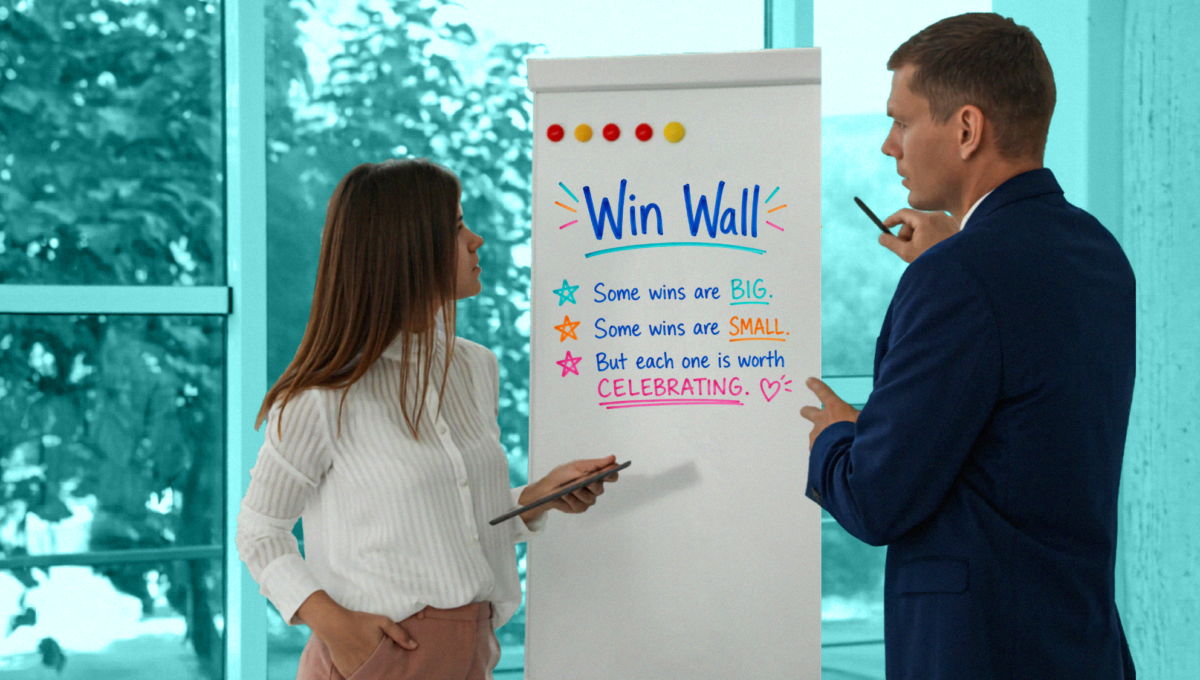
Early in my leadership journey, my staff gave me difficult but valuable feedback: I moved too quickly from one project to the next without stopping to celebrate success. Since then, we’ve intentionally created space to recognize accomplishments and document them on our “Win Wall.”
Some wins are big.
Some are small.
But each one is worth celebrating.
We catalogue each win to look back at the end of the year of how much we’ve accomplished as a team. It’s become one of their favorite — and most fulfilling — exercises.
But here’s where the rubber meets the road: one-on-one meetings. Every employee has a recurring meeting with their supervisor, typically every two weeks.
Gallup reports that employees whose managers hold regular meetings with them are almost three times more likely to be engaged than employees whose managers do not hold regular meetings.
While my employees own the agenda, I developed a simple framework that covers recently completed projects, upcoming priorities, long-range projects, discussion topics, personal reflection, and progress toward annual goals. The structure ensures we talk about both performance and development, not just tasks.
The reflection section receives the least amount of time on the agenda but often produces the most meaningful conversations.
I ask four simple questions:
- What’s working well?
- What’s standing in the way of your success?
- Is there a staff member or department that deserves recognition?
- What time do you want to take off?
Each question serves a purpose. The first identifies strengths. The second helps me remove barriers. The third reinforces a culture of appreciation. The fourth reminds employees that work-life balance isn’t something we talk about once a year — it’s something we actively plan for.
The one-on-one meetings are where those connections to the College’s goals become real and measurable. Better yet, they are happening frequently and regularly, helping each employee understand just how necessary their work is to the big picture.
Now, here’s the full-circle moment: All of this translates into annual performance reviews.
Performance reviews should reflect what’s happened all year, not in the last month or only what you can remember.
I use the notes from each employee’s one-on-one meetings to highlight growth, wins, challenges, and coaching moments. I have a folder for each employee, and I review the agendas and my notes during the performance evaluation process. That way, I’m able to give very specific feedback on their performance during the entire year. And nothing is a surprise — those conversations happened throughout the year.
This approach strengthens fairness.
It promotes accuracy.
And, instead of some freshly inked circles, it builds trust in the review process.
Our college performed a random audit of performance reviews this past fiscal year, and our division’s evaluations were identified as best-practice models. To me, that recognition was evidence that ongoing conversations throughout the year produce more meaningful evaluations than a once-a-year exercise ever could.
The last thing we do in our division (and now mandated throughout the college) that strongly supports engagement is reviewing job descriptions annually.
Think about it: When was the last time you or your team reviewed their job descriptions?
Misaligned or outdated job descriptions are a major source of disengagement.
Let this process begin with your employee. Allow them to review it, redline it and then discuss it with you before updates are sent to HR.
This gives alignment between the role on paper and the reality of the work being performed.
My team members notice the difference. They know these year-round conversations aren’t checking a box. They are opportunities to be heard, supported, and connected to the larger mission of our college.
I still think about that first evaluation. Not because of the scores, but because of what it communicated. The freshly inked circles told me my work wasn’t worth much thought or attention.
That’s the opposite of engagement.
Employees want clear expectations, meaningful feedback, and leaders who invest time into them throughout the year — not just when an evaluation is due. They want to understand their value and know that you understand it, too.
When employees feel valued, supported, and engaged, they don’t simply remain on the payroll. They become advocates, contributors, and champions of your mission.
People stay where they matter. And when they stay, our colleges run better — because engagement is built into the system, not the annual review.