When someone visualizes an idyllic small liberal arts college, they picture Massachusetts College of Liberal Arts (MCLA) to a T: A beautiful campus nestled with historic buildings and cutting-edge facilities — a place where faculty and students mingle together with friendship and ease. Academics are influenced by art, music, and culture, with a vibrant small town down the street and idyllic natural surroundings serving as the backdrop. It’s where deep thinking, connection, and opportunity intersect to create positive change that ripples outward.
As the state’s public liberal arts college, MCLA offers a stellar academic experience that delivers exceptional value. Consistently ranked as a top school for social mobility, MCLA has all the pieces to be a brand name people talk about. But the question repeatedly asked across campus and in the community was “Why doesn’t anyone know about us?”
The Challenge
In 2024, MCLA’s landscape looked bleak: enrollment had been in decline for most of the last decade, awareness was nearly nonexistent, and morale was low. Between 2016 and 2023, enrollment declined nearly consistently, except for small bumps likely driven by another area college closing and reintroducing a hockey program. During that time, enrollment of new first-year and transfer students declined by 41.6%.
Internal stakeholders tried to improve the situation through small marketing purchases when funds became available, but they were often poorly timed for critical deployment. Traditional enrollment marketing methods were often the obvious choice, but without proper omni-channel distribution, awareness stayed low, with no long-term goals or clear strategy. The reality was that these short-term, too-late efforts did nothing to improve results. MCLA was silent in the market, and without a strong digital strategy, recruiters weren’t meeting enough students to convert them. Unless that changed, success would not be secured.
The mission was to pull MCLA out of the slump and build awareness that did not yet exist. This was critical to growing enrollment across the institution, which had mostly declined for a decade. With the high school population shrinking, and Berkshire County and western Massachusetts declining even faster, MCLA needed to attract more students from secondary regions.
We needed to understand how today’s prospective audiences conduct school searches. Gone are the days of simply deploying digital ads and tracking clicks. Engagement now happens through digital optimization, and while an institution’s website is still its front door, students delay visiting an institutional website. For digital optimization to drive strong metrics, we first had to look at where we were sending leads: MCLA.edu. But was our website in good working order? Was the content relevant, up-to-date, and easy to find?
Our Approach
Step One: Weeding the website
MCLA leadership saw that a drastic change in the marketing approach was necessary, with both quick wins and long-term success required at the same time. A major shift in financial plans and institutional thinking allowed modern digital marketing to take shape. But before we could run, we had to crawl. And crawling the website was the first place to start building a digital presence that was seen, a place where MCLA’s story could unfold, and take viewers from engaging with us digitally to coming to campus, and eventually becoming MCLA Trailblazers.
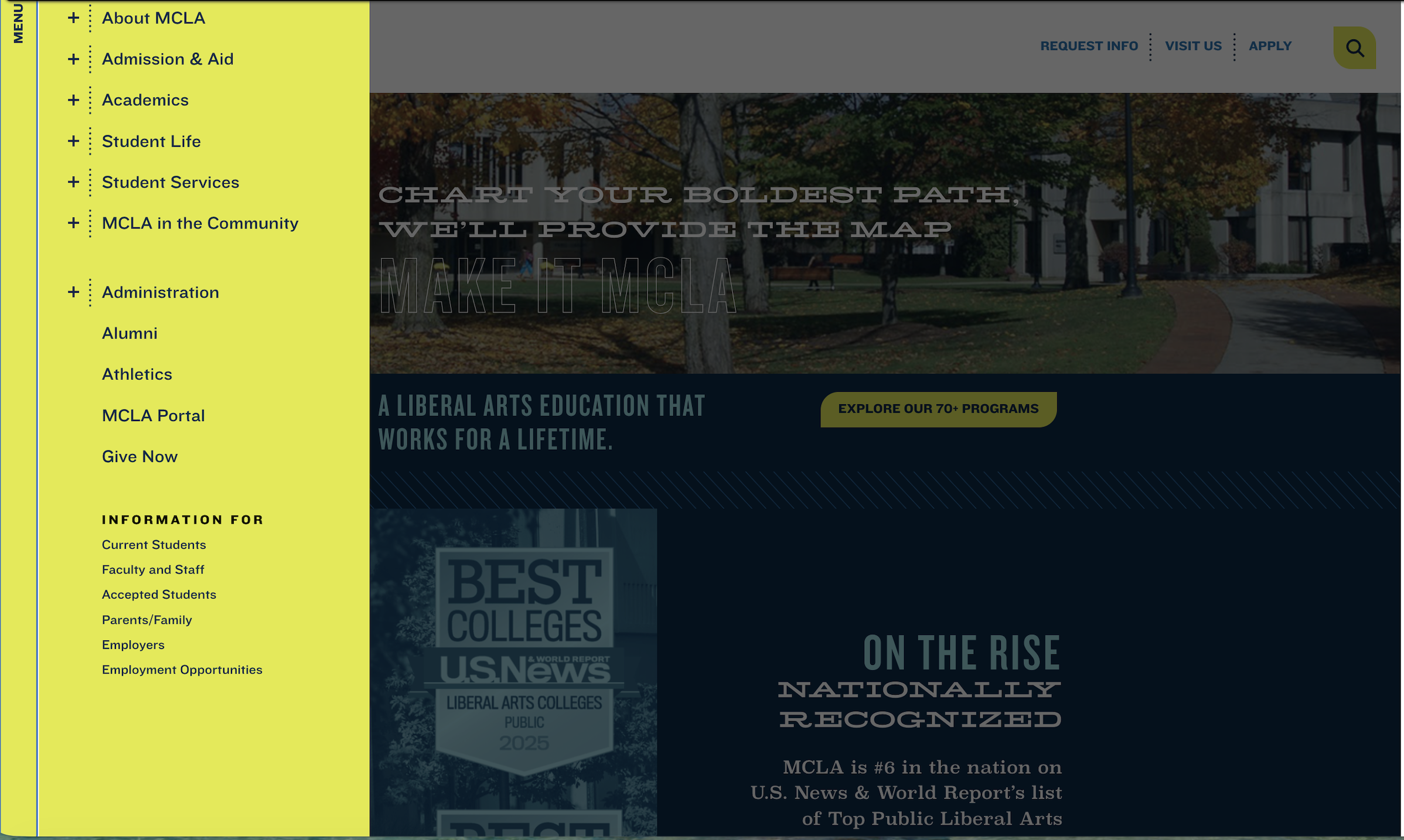
When people visit an institution’s website, they expect information right in front of them, with AI-powered search, easy navigation, and faces of real students looking back at them and explaining, in their own words, what MCLA is like. The former MCLA.edu wasn’t in terrible working order, but the structure and layout needed improvement. The navigation was vertically stacked on the left-hand side, which was counterintuitive. Pride metrics weren’t prominently displayed, and student voices were almost entirely absent. The content was mostly informational, with no consistent layout and no second tone to engage the reader. Parent pages led to unneeded clicks and multiple child pages. Often, the content could be distributed on the parent page to keep readers engaged and increase time on site.
Step Two: Choosing a champion and deciding who owns the website.
Without a strong web governance and ownership process, anyone with CMS access could publish content live with no review or oversight to ensure accessibility and brand style were maintained. It also meant outdated data-driven pages were often left live too long. This led to improper search results. For example, multiple years of Orientation pages were live, and Google often incorrectly selected an outdated page as a top result. We also had an inauguration page from 2016 still live, and we had just welcomed our new president, who was planning her upcoming inauguration. This allowed AI to hallucinate a response based on content it accurately reviewed, but it was woefully outdated content that should have been taken down years earlier.
We began by reviewing the total pages across the web, then focused on those with the fewest page visits in the last year. If we could kill a page without a redirect, we did it quickly. Pages that needed updated content or redirects took longer. We also removed unnecessary items, such as Board of Trustees meeting minute archives from years and decades ago that needed to be digitally available. We moved these to an archival area of the website, available upon request, so they no longer clogged the site pages and navigation. Like laundry, this work is ongoing and will never be complete, with reviews throughout the year and a deeper audit each year before the academic cycle begins again. We must maintain information such as tuition and fees, student headcount, rankings, and other accolades everywhere. Tracking how many pages across the site house this information is key to ensuring accuracy and consistency.
We developed an MCLA factbook for media relations and content consistency. One owner updates the fact book, and it is used for the website, when media outlets speak to us, and to update third-party pages such as Wikipedia, Niche, and WikiAnswers. Whenever a new fact becomes available – whether it is a faculty research piece, a development figure, or a substantial gift – the factbook champion updates all placements and timestamps the book, archiving previous iterations and ensuring that the most up-to-date information is shared with internal constituents.
Once this was underway, we needed to ensure content on the program pages was accurate. Gone are the days of a program parent page with nested child pages. We had to ensure our content was clear, written in second person, and free of repetition so both humans and machines could review our offerings and take action. Our provost understood the value of showing up in search and generative conversations, and made the bold decision to inform the faculty that their program and department pages were no longer under their ownership. Marketing would now own the pages. While this was a shock at first, we had strong examples to share why this change was beneficial.
We beta-tested this process with two programs. Within four weeks of updating these two program pages, RFI forms for their programs grew by 25%. The argument to have marketing maintain the pages was clear: more program page views would mean more students enrolled. We worked with faculty to ensure the content was accurate and the selected images were mutually agreeable. They understood that unless there was an error on their program page, they had to step back and allow us to maintain the page.
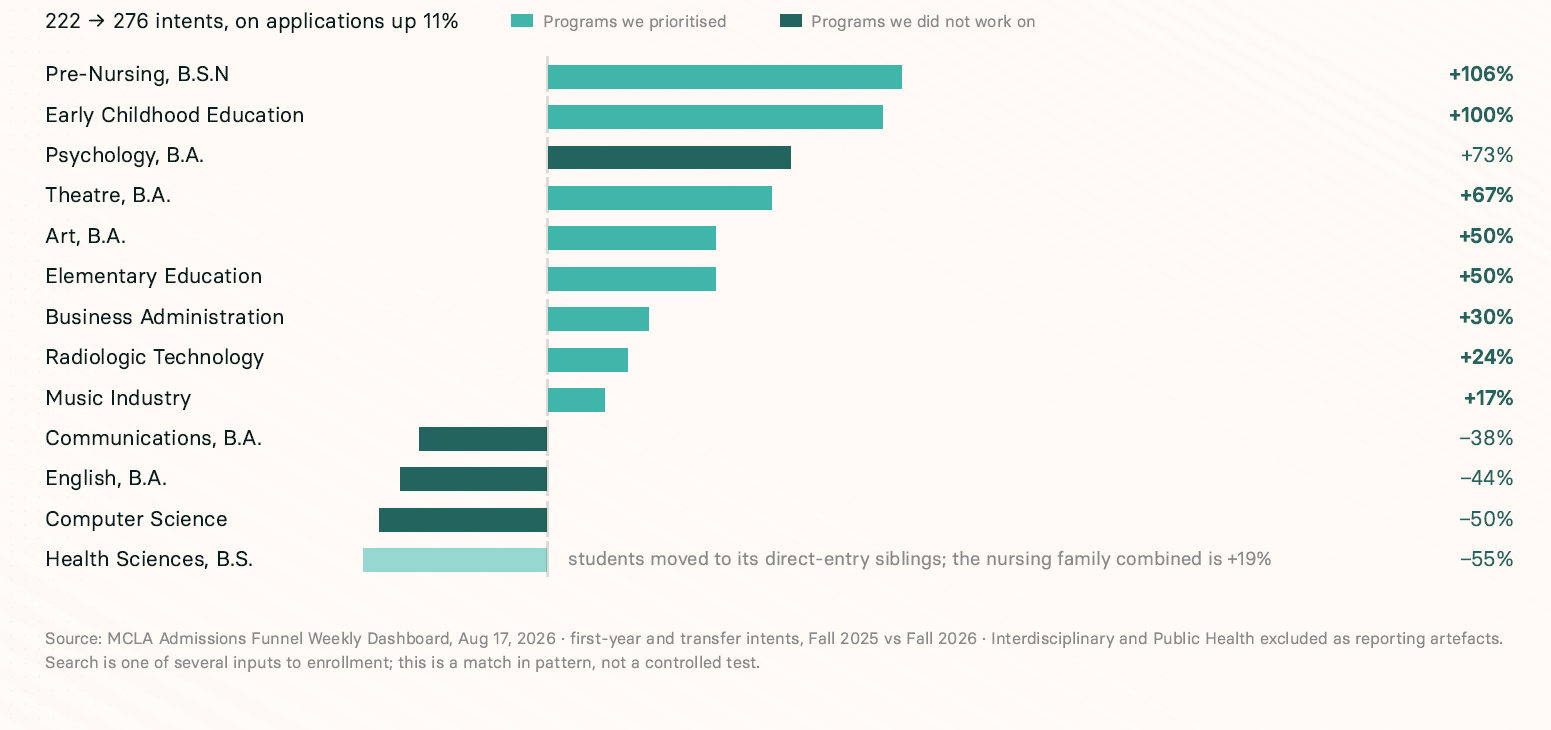
It took most of the spring to go through the program pages to optimize them for search. Not all programs were improved in time for the application cycle. However, 18 of our 30 undergraduate programs saw an increase in applications – a 60% improvement over 2025 – and an overall 25.7% increase in deposits.
We reviewed what was outdated, out-of-compliance, and misaligned messaging. Web governance needed to be enforced. The work is not glamorous, but it acts as an insurance policy and reduces digital compliance risk to the institution.
Step Three: Improve the digital front door and student journey
MCLA’s website had counterintuitive navigation design, and a homepage that read like a community newspaper rather than a vibrant college community with students at its center. That had to change, and change needed to be within financial reach. While we didn’t have funding to revamp the entire site, we selected the digital agency ERI to give mcla.edu a facelift by improving the homepage and embedding student stories there and on other complementary brand pages.
The homepage now features a social media tile for omnichannel cross-pollination, a “Make Connections” section, and a “Voices From our Community” section that are filled with short-form student and faculty video testimonials and prominent accolades. These new secondary pages homed in on our brand promise: Empowering Creativity, Transforming Futures, Get to Know Us in Person, On the Rise, Nationally Recognized, and Keep on the Trail. The videos speak to the audience, not at them, to ensure engagement and substantial time on page. ERI implemented enriched storytelling after conducting thorough focus group analysis and applying its SOAR Analysis (Strengths, Opportunities, Aspirations, Results), which started the project on a positive track and ensured strong stakeholder buy-in.
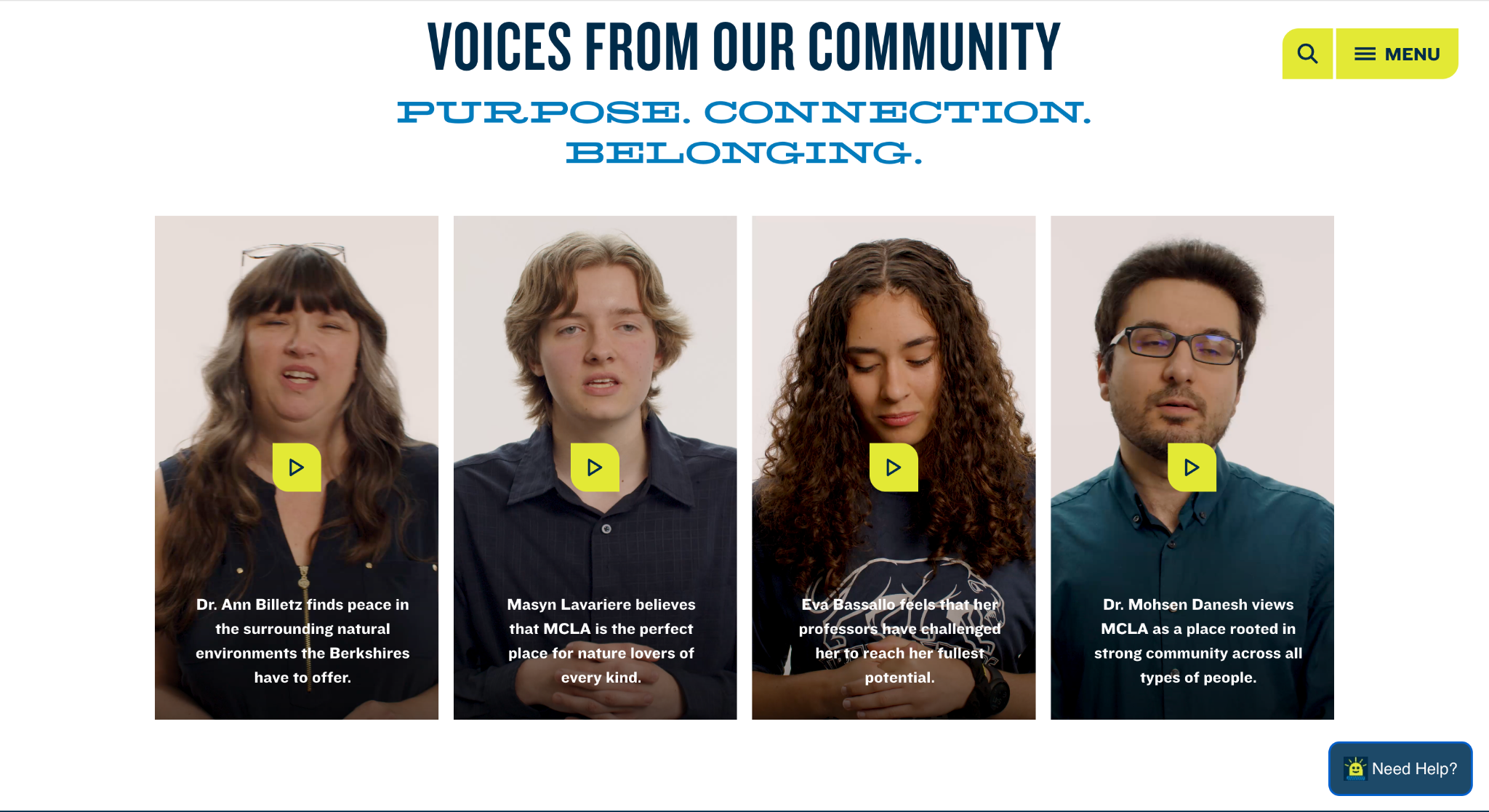
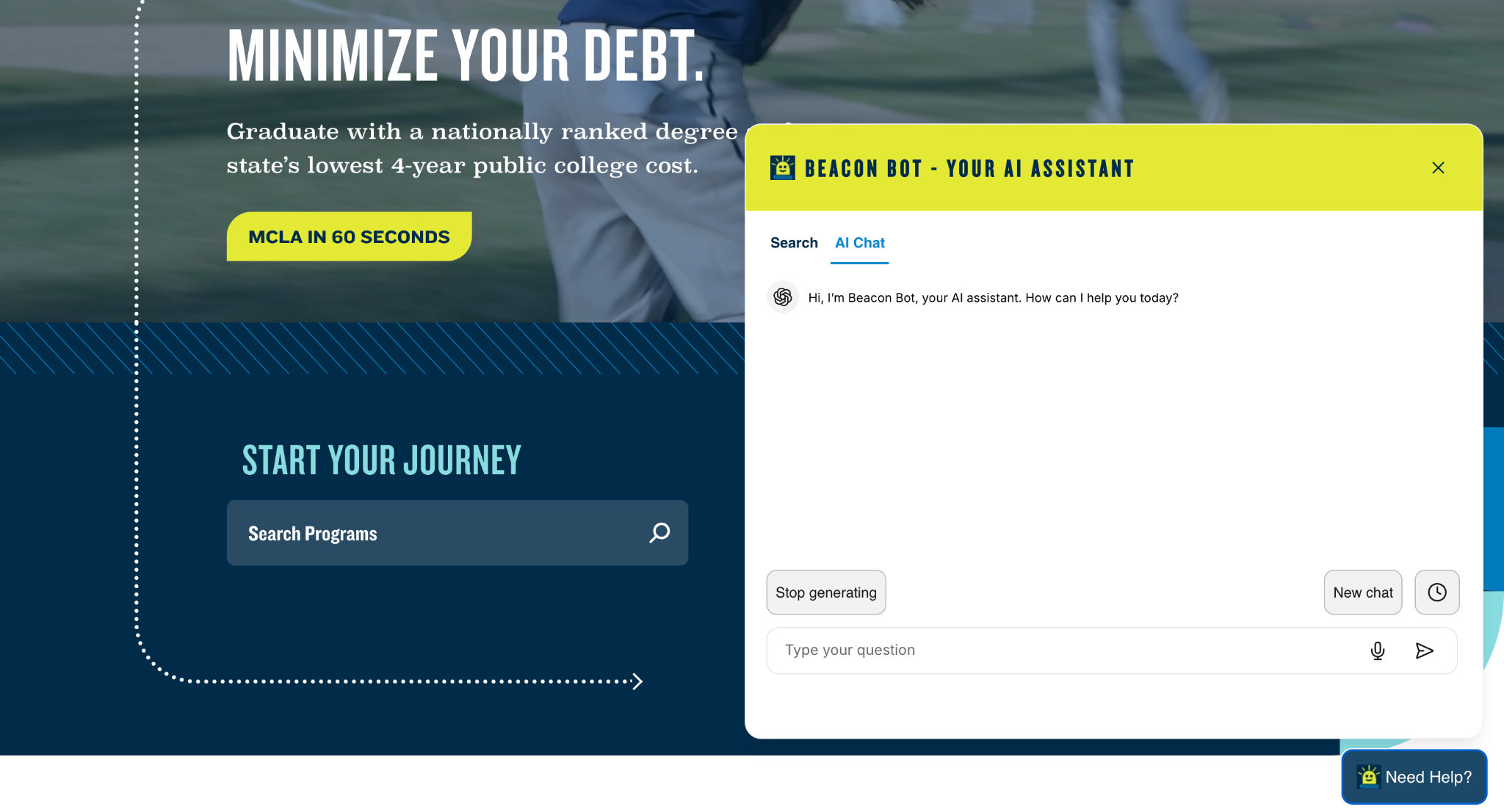
The last piece of work implemented on the enhanced site was an AI search agent powered by Cludo, which the student body named “Beacon Bot,” after the famed beacon atop the state’s highest mountain that can be seen from campus. When we launched this project, we knew our digital story was now current, accurate, and positioned for the audiences we served. With that in mind, it was now time to begin our Generative Search Optimization (GEO).
Step Four: Media Relations and Marketing are no longer siblings. They’re conjoined twins.
While different institutions have individual organizational structures based on their needs and culture, communications and marketing must align more closely than ever, even in this AI environment. Each time there is an earned media opportunity, a press release is pushed out through the newswire, or a presidential speech is posted on social media, that is a chance to ensure institutional brand messaging and key points are mentioned so repetition can take shape in an omni-channel way for best optimization.
We worked to ensure our brand promise messages appeared on major pages across our site so generative machines could pick them up. That meant repetitive content written to engage both human and machine readers. Working on phrases and terms we wanted to land with prospective audiences, we then reviewed where the terms should live on the individual pages, and how we could work those terms into listicles and other hosted content across the website to ensure AI would review our brand values not only on MCLA.edu, but through other sources to improve validation.
In short, AI is only concerned about the richness of information it can find on a school or higher education topic. Institutions that put key points out in as many ways as possible will see better performance, with stronger narratives that convince search audiences they are a valid choice.
MCLA’s communications and marketing units have separate reporting structures, but that does not create an unnecessary silo and stunt information sharing. Working together, our areas ensure media relations efforts keep brand and marketing in mind. We meet bi-weekly to review potential earned media engagements and how they tie back to the key brand points outlined in the market research we conducted. This collaboration has been exciting because we see the bigger picture at play, and traction has steadily increased since we began communicating and working together more.
What We’d Do Differently
Something that surprised us when we officially flipped the switch and turned on the new website enhancements was that so many adjacent items in development needed more time. We had to be OK with having major new components live, but not all of them. For example, the main page calendar needed development tweaking, so that our 25Live events calendar could automatically populate into Modern Campus. That took time, and we had to implement a manual workaround while development finalized the integration.
After years of digital bloat without proper maintenance, search result errors are to be expected. We simply didn’t realize how many we had across our site. We spent the first 90 days focused on fixing errors and addressing content issues related to erroneous search results. When we launched our AI chatbot on the site, it was wonderful but initially served up a lot of misses. We emailed the entire MCLA community about the new website and asked for their help improving the chatbot. Cludo has a clever “thumbs up/thumbs down” button. If the chatbot gave a poor response, we asked the user to “thumbs down” and tell us what was wrong in a brief content box. We tackled those errors first, then reviewed content across the site to ensure our chatbot would give accurate answers. We also found many search terms we never imagined being asked, but reviewing the questions posed on the site helped us identify information gaps and how best to close them.
Hindsight is 20/20, of course. When we launch a site refresh in the future, conducting a focus group around search and testing more adjacent components before the live date will reduce the digital errors prospective audiences may see. Oh, and I pushed to have the site live before the Thanksgiving holiday, knowing many students apply to colleges then. Launching a site over a holiday weekend isn’t recommended, because if something goes wrong, the people who can fix it are away for several days.
As I write this, I am proud to say that MCLA has achieved two consecutive years of enrollment growth, and an incredible 25% enrollment increase from Fall 2025 to Fall 2026. We then developed a more robust set of data-driven reports and tools. We are doing all this with three marketing employees. Our annual marketing budget is among the smallest in the Massachusetts public college system. We made these gains through clear goals, sound execution, and measured risks. Many of the decisions made were the opposite of what we heard our peers were doing. We are happy to say our decision to be bold is working, and MCLA’s leadership fully supports our work.
Our Results
The outlined work began two years ago, and we started engaging more closely with GEO in early 2026. AI visibility improved across all prospective audiences and was key to securing more enrollments:
- 57% fewer unanswered queries on MCLA.edu
- AI mention rates increased from 7% to 30% in the first two quarters of 2026
- AI URL citations increased 52%
- AI citation positioning became the #3 most cited higher ed domain in Massachusetts, highest amongst all public Massachusetts institutions
- 60% of programs saw inquiry growth after page optimization
- M.Ed. enrollment deposits increased 138%
- New undergraduate student enrollment increased 25%
- 63.8% reduction in prospect leads from 2025, making way for a pipeline model to take over and make way for efficiency and engagement with true-fit audiences.
The results validated our original strategic mindset shift. Generative search wasn’t a nice-to-have; it was a must-have. The work needed to support this isn’t in one area; it is scattered across all areas of communication. The more variety of sources AI pulls from, the better the institutional results become.
Conclusion & How to Get Started
From late fall to spring, the MCLA landscape shifted dramatically in a positive way, and we attribute much of that to the bold decisions we made to clean up our digital ecosystem and front door to ensure we were in the best shape possible for AI.
The urge to hurry up and join the AI playing field is real, and I see the buzz becoming louder and louder across the industry. I agree: it’s a game-changing tactic, if done well. But like anything, if you put garbage in, you will only get garbage out. Clean up your institutional digital ecosystem first before you dive in.
Our checklist lets you learn from our process and apply them to your institution’s website.