When ‘Featherstone University’ hit the internet, higher ed took notice. The satirical campaign from Colorado Mesa University (CMU) pokes fun at exclusivity in college marketing and sparked conversations far beyond its Western Colorado roots.
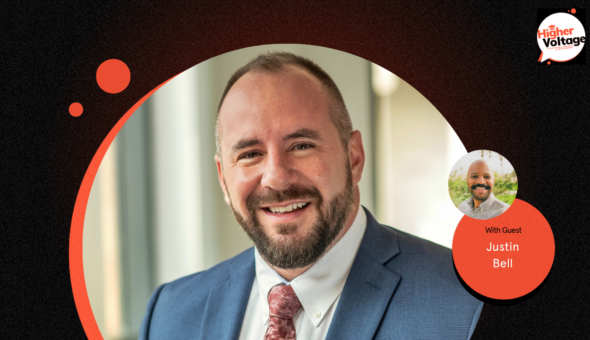
In this episode of Higher Voltage, Kevin Tyler sits down with Katlin Birdsall, CMU’s AVP for Marketing and Brand Strategy, to unpack the thinking behind Featherstone and why it matters.
The campaign’s humor may have been unexpected, but Birdsall insists its message is serious: higher ed’s value proposition is eroding, and rebuilding trust starts with authenticity and being true to your values.
Rooted in CMU’s strategic plan, the institution’s marketing team translated a campus-wide conversation about access, affordability, and belonging into a campaign that hits close to home. Nearly half of CMU’s students are first-generation college-goers, and the institution’s messaging reflects that reality: higher ed should open doors, not guard them.
Birdsall credits the university’s leadership for embracing risk. The spot’s success—garnering hundreds of thousands of views, national media coverage, and community buzz—proved that bold storytelling still has a place in higher education.
“Taking risks for the right reasons is worth it,” Birdsall adds. “When it aligns with who you are, that’s when real connection happens.”
Read the full transcript here
Kevin Tyler
Hello and welcome back to Higher Voltage, a Volt podcast covering the latest trends in higher education, marketing and administration. And with everything that’s going on in the industry, there is a lot to cover. I’m your host, Kevin Tyler, an industry veteran, and I’ve worked on both sides of the fence at institutions like UCLA and various higher education agencies. And each episode, I talked to industry experts to get their take on what’s working, what’s not, and what has to change. Higher Voltage is produced by Volt, the go to news source for higher education marketers and enrollment professionals. You can visit Volt at voltedu.com and subscribe to Higher Voltage on Apple Podcasts, Spotify or wherever you get your podcasts so you don’t miss an episode.
Kevin Tyler
Hey hey hey, welcome back to Higher Voltage. I am so pleased to have you join us today for a riveting conversation with Katlin Birdsall, AVP for Marketing and Brand Strategy at Colorado Mesa University.
Now, listen, if you have not seen the most recent campaign from Colorado Mesa University, you must be living under a what? A Featherstone. Whether you love it or hate it, you’re likely talking about or part of conversations about the satirical ad campaign launched by CMU. The ad, which pokes fun at the exclusivity and elitism of some institutions in the market, is causing quite a stir in the industry. Joining me, like I said before, is Katlin Birdsall, who had a critical role in the development of this campaign.
And before we dive into the components of the decision making, the data, the outcomes and the performance, I just want to share a couple of fast facts about Colorado Mesa University. It has one of the highest numbers of first generation students in Colorado, with this group making up about 47% of its student body. The enrollment is just over 10,000 individuals. Student to faculty ratio is 18:1, and it really prides itself on, as the tagline states, seeing the student and not really caring about where you’re from, who you know, how much money you make, what kind of family you come from. And that’s what we’re going to talk about today. Katlin, welcome to Higher Voltage.
Katlin Birdsall
Thank you so much, Kevin, for having me on today. I’m excited to talk about Colorado Mesa University and our new campaign, Featherstone.
Kevin Tyler
I am excited as well. Now, I have already mentioned the stir that this ad is causing, and quite frankly, I am not sure just yet how I feel about it as a long term higher education marketer and brander. But my feelings aside, what is the message you hoped to communicate here and who is it for? How does it relate to who you are as a university? Let’s get to the brass tacks first, and then we’ll get into some of the other conversation later.
Katlin Birdsall
Yeah, I have to say, it’s been really interesting and fascinating to see the conversation that’s happening around the campaign now that it’s launched, and specifically with higher ed marketing experts and just higher ed executives in general. We knew when we were making this spot that it would not be for everyone. We knew some people would love it. We knew some people would hate it. We knew some people wouldn’t understand it. But I think because the spot really does have a through line and ties back to our values, our vision, and our mission as an institution, that we were okay with taking that risk, if you’d even want to call it that.
Kevin Tyler
How closely does this align with the positioning of CMU, and how it exists in the world in other places?
Katlin Birdsall
Yeah. So really for CMU, we are student focused and the students we serve are, you know, 47% of our students are first generation. And when you say that it’s like first generation, the first in their families to go to college, and there’s 47%of our student body that fit that category, we also serve a higher proportion of lower income students, students from rural areas of the state. And so, because of the students that we serve, we find it’s important to be able to break through to them and show them the value of higher education and doing it in a way where hopefully we don’t take ourselves so seriously.
Kevin Tyler
I’m curious to know, and I love that you serve the first generation population. I think that is a critical audience that higher education can really benefit from inviting into its doors in a more intentional way. And so I’m really glad that you exist in that way. I’m curious if this ad is positioning CMU as anti-elitist. Is there an institution that Featherstone University, affectionately known as FU, is standing in for?
Katlin Birdsall
It’s not. I think that was very intentional that we didn’t want to call out any one higher education institution. But I think there is a stark contrast between a lot of the elite and Ivy League universities and CMU. And that’s okay that we offer different things, that we have different priorities and we have different students that we serve. But I think we’ve seen in, you know, a lot of the Gallup polls, you know, even just a few decades ago, two thirds of American families saw the value in higher education. And over these last few decades, we’ve seen that steadily decline. And right now, I think it’s around 25%, maybe 30% believe and trust that higher education is fulfilling what it needs to be doing for our society and to better our society and to serve the people that we serve. And that’s a real problem and an issue. I’m grateful that I’ve had the opportunity to work on a campaign that’s willing to tackle something so important, and do it in a way that hopefully breaks through and shows that, you know, in higher ed, you don’t always have to be so serious. Even when we’re talking about serious issues.
Kevin Tyler
Absolutely. I could not agree with you more. And quite often, as a matter of fact, on this show, the refrain that comes up most often for me is that what got higher ed to where we are now is not going to be what it takes to get to where we need to be next. And I think that these new approaches to marketing institutions, marketing the value of higher education have to have new sounding tricks, tips. Something else has to happen in order to attract the folks we need to attract and help educate those who have forgotten what the value of higher education looks like. One of the things that comes to mind most immediately for me, that you raised in your response is that the timing of the ad drop, right? And, you know, some of the criticism of the ad is that it comes at a time when there are so many challenges that are just facing the entire industry. Higher ed is taking hits from every corner, every side. And it could also be perceived as painting all of higher education, including institutions that are really doing really, really great work, whether it’s community colleges or HBCUs or those that are just not considered elite with the same brush. And I’m curious if critics ask, of all times, why create this campaign right now? What would you say to them?
Katlin Birdsall
Yeah, so I think again, for us it really goes back to our values, vision and mission. And so for CMU, it was, president Marshall came on board as our president in 2021. And then we went through almost a two year strategic planning process called Forming the Future. And kudos to president Marshall, per his usual. He was like, we’re not going to do a strategic planning process the way that most institutions do. So he threw out that playbook, and really we dug into who we want to be as an institution and what we stand for, because I think we all know that in marketing, if you’re everything to everyone, you’re nothing to no one. And so we really… Yeah. And so we really dug into like, who are we and who are the students that we’re serving. And so we identified our seven values. And those are love, dignity, courage, curiosity, resilience, humility and power. And we really honed in on this human scale university motif which was sent by president Marshall. And he says, you know, we’re acting as a human scale university when we’re a model of the world we want to create. And as we were working through that process, we had a faculty member, who I really appreciate was like, well, who are we to say what world we should be creating? Like, how should you as the president or us as an institution, be the ones deciding that? And so that’s where our seven values came from. And we literally had a group of 47 faculty, staff and students that wordsmithed definitions to all seven of those values. And as anyone in business knows, wordsmithing with a group can be painful.
Kevin Tyler
What are you talking about? We have no idea what you mean.
Katlin Birdsall
But we did. We came up with definitions that are true to CMU and what we’ve, you know, ultimately decided is that if we’re embodying these values, even if imperfectly, that we will start building a model of the world we want to create. And so, you know, that was really a foundational piece. And then president Marshall, again, in his tenure, is he’s saying similar things to this while he’s out on the road. So we did, um, the CMU Promise tour. So a lot of institutions have a promise. Ours is that if your family makes 70,000 or less and you live in Colorado, we’ll cover your tuition full stop. But president Marshall was like, you know, I don’t want to just have this promise. I want to make it meaningful. So he actually hit the road and visited, I think, almost 20 different high schools here in Colorado. And he said, he’s like, I don’t want to go to the high schools that everybody goes to. I want to go to those rural, kind of forgotten places to have the conversations and deliver this promise. And so he went to Nucla Naturita, he went to Fort Morgan. And I guarantee you, if you ask anybody here in Colorado, they think Grand Junction, where we’re located is as far west as Colorado goes, but Nucla and Naturita is another two hours outside of Grand Junction. And he went to these very small, rural, kind of forgotten communities, and he had conversations with students there and listening to him talk about the real problems that these students are facing and the challenges that they face day to day, not only on deciding whether or not to go to higher ed, but it’s like, you know, am I going to work to help support my family, or am I going to be selfish and pursue a higher education degree that will hopefully pay off in the future? You know, these were real conversations that he was hearing. And so for him, it just reinforced our mission and the students that were serving. And so he came to our team, which is led by our VP for communications, David Ludlum, and he said, he’s like, I’m out here on the road. I’m talking to students, and I’m telling them the truth about higher ed and that here at CMU, they have a place to belong. We’ll find a way to make it affordable. We’ll find a way to make it accessible. And he’s like, I want to see that same messaging reflected in our advertising. And so really, it was a challenge from president Marshall of, you know, find a way to take what I’m communicating to students and to parents and to counselors and to community members and donors, and find a way to put that into our advertising and have it break through. And it was a challenge for sure.
Kevin Tyler
I bet. I mean, it’s really great to hear that there’s a president willing to make that kind of investment to understand the communities that are in the state that he serves, without even them being students on their campus just yet. I think that really means a lot, right? Going where people are and meeting them where they are for these kinds of really important conversations.
I would love to, like, get into the development of the ad, right. Like, I’ve been the lucky beneficiary of being in rooms, working at agencies as ads or, you know, being developed, thought through, conceptualized, which is an incredibly inspiring and an exciting kind of room to be in, of creativity, of that, of that level. We talked a little bit about the qualitative data, right. His conversations around the state. I’m curious what other data you use to inform the tone, the personality of this ad, what it aimed to do, the target. Can you share some of that information?
Katlin Birdsall
Yeah. So I’ve been at CMU for a little over 9 years now, and I’ve said this is by far the most challenging project I’ve ever worked on, and so far one of the most gratifying because I feel like for all of us, you know, there’s not always this opportunity where everything lines up perfectly to be able to execute a campaign like this. And so this has been challenging, to say the least, but also incredibly gratifying. And, you know, starting from the beginning and your question around data, I find that to be a great question. But people might be surprised by the answer that, you know, there wasn’t a lot of data supporting this strategy for us. It really did go back to those values, our vision, our mission, and what president Marshall kind of tasked our office with accomplishing with this campaign. And I think that’s a good lesson that I learned through this process, is that if you’re creating a campaign that really ties back to who you are as a brand, as an institution at your core, then you know you’re on the right track. And like I said, some people love it, some people hate it. But we know that we’re on the right track and didn’t have to do a ton of, you know, data to support what we wanted to do, because we know that it’s who we are as an institution, and it’s just saying it in a way that will hopefully catch people’s attention.
Kevin Tyler
Which, clearly, it has.
Katlin Birdsall
I think it’s working so far, so far, but we still got our ways to go.
Kevin Tyler
100%, yeah, totally. It has been a very powerful message, one way or another. I’m curious, like, was this an institution led effort? Was it an agency led partnership? How did this come to come together?
Katlin Birdsall
Yeah. So, you know, we’re kind of a small but mighty internal marketing team, and so I have to give kudos and shout out to my team that really played a role in, I think, taking President Marshall’s charge and running with it. And then we did work with a number of creative partners, um, and agency, a production house, a creative director, and then one that I absolutely love is that that end scene, where our hero kind of walks on to CMU’s campus that was actually filmed by some of our CMUTech digital filmmaking students and alums. So part of CMU, part of Colorado Mesa University is also CMUTech, which offers our career and technical education programs. And so we were able to work with current students and alumni of that program to film that kind of last five seconds of the spot. So they got to play a role in it, and they’ve all been over the moon to get to see, you know, their work out there in a real campaign.
Kevin Tyler
Of course. How dope is that? I love that. To incorporate student expertise in efforts like this, because what better storytellers are you ever going to have than the students who already attend your institution?
Katlin Birdsall
One other thing I thought that is interesting is in the end, we have a couple of students that are standing on campus to welcome our hero. And one of those students is Leilani Domingo. She’s our associated student government president. And so it’s been really cool to get to involve her in the process because, you know, we’ve worked with her throughout her tenure as our student body president. And she was really excited when we told her, like, here’s the project, here’s what we’re working on. And she has said, I’m that student, I’m first generation, I come from a lower income house. I come from a very rural area. And she’s like in CMU, you know, from the time I stepped on campus, felt like home and felt like I belonged. And they’ve given me more opportunities than I could have imagined. And so it was really cool that we got to involve Leilani in the project as well.
Kevin Tyler
Just a point of curiosity for me, was the Featherstone piece AI? Or, I mean, the horse? Yeah, there was a horse in it, so we have to talk about there being a horse.
Katlin Birdsall
So no, in our 90-second, you know, commercial that we have for Featherstone, there was no AI. That was all filmed and edited. You know, that’s the comment or a lot of the comments that I see swirling, you know, is it AI? And it’s like, no, the commercial was not produced with AI.
Kevin Tyler
You heard it here first, folks, or maybe second or third, but you heard it here. Uh, that there is no AI. How are you measuring the success of this ad? And I guess as a follow up, do you envision this being a bit of a campaign, like an actual series, I guess, or is it more of a one and done situation?
Katlin Birdsall
Yeah. So this is, you know, our current recruitment campaign and it’s a whole omnichannel strategy. So we’ve got our 90, the 60s, the 30s, the 15s, working on the six seconds. Because trying to fit this story into a six second is not easy to do. We’ve got, you know, static ads. And so, yeah, it’s an entire campaign. But we have talked about that. We feel like there is room for this to grow potentially, you know, seeing how the feedback goes. Seeing long term what the impacts are on our brand awareness and affinity and with enrollment numbers. But we thought it would be really cool to iterate off of this Featherstone concept. And, you know, maybe in the next iteration we have a Featherstone student come to CMU campus or we talked about, you know, doing a side by side comparison because of course in the Featherstone commercial the tour is given, you know, by a very prim and proper headmistress. And here our tours are given by students. And so we thought that could be a cool comparison. So I’m hoping, professionally and personally, that there’s some legs to this, because it was a really thought-provoking campaign that we’ve worked on, and I think that the creative possibilities are not done yet.
Kevin Tyler
100%, I agree with that. So the president comes back from his travels around the state with a collection of stories. And then there’s this concepting phase, right? The creative concept, what are we going to say, how are we going to say it, what’s the tone, etc. And you come up with Featherstone University. I’m curious, how hard was that to sell back to the president, if at all. And what that conversation may have looked or sounded like?
Katlin Birdsall
Yeah, well, I can’t say enough good things about president Marshall because he got it immediately. Like, I went in, read him the script. And, you know, reading that script to your president is a little nerve-wracking. But, I mean, he got it immediately, and he was like, you know, this is not going to be easy to produce, easy to execute. He’s like, there’s a lot we need to think through from now until moving into production and even after production and once we move into putting this out into the world. And so we had a lot of conversations internally. I really appreciate also a lot of the feedback from our leadership team, because there were many of them that were not on board in the beginning. Or had, I think, valid concerns about the approach that we were taking. But I feel like the culture that we have here and the ability for them to be open and honest with us, and we really took that in and it helped us iterate and make the spot better. Like one example I remember, David, so our vice president for communications was talking with one of our other leadership team members, and he’s like, okay, like, I just want to sit down and, you know, get it all out. Tell me everything you’re thinking, feeling, like, what are the concerns? And, you know, one of his concerns he brought up was in the beginning, he was like, I feel like there’s too much of an emphasis on the joke and not enough on the hero and their journey. And that was great feedback because there was a little bit too much emphasis, if you can imagine, in earlier renditions on the joke. And through his feedback, it was really insightful, and we were able to iterate creatively because we were early enough on in the process, and it helped us actually get better and made the spot better in the end. And so it was a lot of conversations. It was a lot of, I think, sometimes self-doubt on my part, of like, is this right? But I’m like, no, this is right. And for me too, I’ve really wanted to set CMU apart in a way where there are so many good university commercials, but there are so many of them that you could take the logo out and put another logo in and you would have no idea the difference. And I mean, we’re guilty of creating spots like that in the past, the students in the small classroom with the faculty member who’s engaged, and then they’re looking through a beaker, and then they’re throwing a football on campus, and they’re enjoying their time in their res hall together, like we’ve all shot spots like that, because that is the realities of campus life. But we wanted to do something that was really different and would break through to those students and those families that hopefully would need to hear it the most. And we all know you’ve got about three seconds to capture people’s attention as they’re scrolling on Instagram or TikTok or watching a show on Hulu. And so I think that’s why it was so important that we tried something different. And then I’m just really thankful that we had a leadership team and especially president Marshall, who understood that and trusted us to be able to to get it done.
Kevin Tyler
I think the trust piece is, I think, a huge component here, of course, right. I have worked with institutions who at the beginning of a process were, you know, begging for bold, right? And we went through the whole process, gave bold and like, it’s too bold. I can’t do it. I can’t do it. I’ve also worked, conversely, with institutions who where, the client was like, this feels very uncomfortable for me. And I like that. That’s why it’s right. And so there are two very different kind of perspectives when people want, you know, quote-unquote bold. And having that level of trust and the team that you’ve hired to market the institution should come with a level of trust that allows for things like this to see the light of day. And having a leadership team, as you mentioned, who supported all the way through with anecdotal, qualitative and quantitative wherever possible, that’s always important to include as well. Is this a national buy or are you focused on certain markets? I’m just curious about the brass tacks of the campaign.
Katlin Birdsall
Yeah. So we’re definitely focused, you know, here in the state of Colorado, that’s where the majority of our students come from. And so most of the paid advertising will be here in Colorado. And then we do have some and some key out-of-state markets for us. So that would be like California, Texas, Hawaii and Minnesota. Those are much smaller buys, just because we can’t, you know, we don’t have enough to do all of the states, right? But yeah. So I wouldn’t quite call it a national campaign. But yeah, we are throughout Colorado and then some of those key out-of-state priorities. And then I think that’s been the other really cool part for me as we’ve gone through this process, is that it’s not just the paid, but we’ve been really intentional from an organic and an earned media and a public relations piece, because we felt like this campaign could warrant that type of a coverage. And that’s where you’re seeing more of that national, I think, recognition. You know, launching it with Kyle Clark on 9News, like you mentioned earlier, he is I mean, he’s a journalist, he’s an investigative journalist. And he has a style all his own. And it was a risk because he could have torn us apart. And we were fortunate enough that he, same thing, understood it, got it. And I was really grateful that he was willing to cover it because he had said he’s never covered an advertising campaign before. But he had told us that he thought it was genuine and provocative, which he doesn’t get very often. And so really, I think that helped launch once president Marshall was able to go on and talk with him. And if anybody hasn’t listened to that full interview between president Marshall and Kyle Clark. I’d really encourage you to go and listen to it, because, I mean, nobody says it better than president Marshall of why we did this campaign. And so I think that really helped then launch the conversation that we’re seeing today, both online and in different coverage of the campaign.
Kevin Tyler
I totally agree with you. We will have a link to that interview on the episode page for this chat. Because I do think it’s important to hear the president’s perspective. And I really think that it’s incredible that, you know, as you say, an investigative journalist of the caliber of Kyle Clark, who, you know, pulls no punches, absolutely no punches on a regular basis, having this kind of conversation with the president about this campaign, I think adds, I would not say legitimacy or validity, but a certain weight to the conversation that makes it feel a bit more important than if it was just kind of a, you know, beat reporter saying, here’s a new ad from Featherstone University. I’m just kidding.
Katlin Birdsall
I completely agree.
Kevin Tyler
One of my most intense curiosities is what you’ve heard from alums about the campaign. What are they saying?
Katlin Birdsall
Yeah. So I would say 99% of the feedback that we’re receiving has been positive. And people are like, I love it. And it’s so CMU or glad somebody’s saying it and doing it. It was funny. And they’re like this, like the satirical, humorous nature of it, it is so refreshing for higher ed. And so I would say about 99% has been positive. And then, yeah, there’s the one percent who either don’t quite understand it or they don’t love it or, you know, they don’t think it’s quite right. But like I said, when we started this process and, you know, chose this creative concept to move forward with, we knew that there’d be some that didn’t love it. But I would say for the most part, it’s been pretty positive. And I can say personally, this has been the first time where I’ve actually had people stopping me or reaching out to me and asking about it, which just personally is really cool. Because, as you know, a marketer at heart, you hope that the work that you work on breaks through and people actually pay attention to it, because so much of what we create, people just scroll right past it or skip right over it. So I was like, just personally, it’s been really cool. Like, I was at my children’s gymnastics class on a Saturday morning and an alum stopped me and she was like, you work for CMU marketing, right? And I was like, yeah. She was like, did you have anything to do with Featherstone? She’s like, I love it. She’s like, it was amazing. And, you know, unprompted. And it’s like 9 a.m. on a Saturday morning. And so that type of feedback just personally has been really, really rewarding. And then I think I’ve really appreciated that both David and president Marshall have continued to send me the feedback they’re receiving, whether that’s from other higher ed professionals, policymakers, state legislators. And so that’s been really refreshing to see that positive take that a lot of people have taken on it.
Kevin Tyler
That’s great to hear. I’m curious, you know, unfortunately I did not do much research, which I am now kicking myself in the face for, around how the state legislature has been funding higher education in Colorado. Have you heard any, have you gotten any feedback from legislature as you mentioned, that’s positive or feels like you might be changing the tune or softening the ground for some of the decisions being made at the statehouse?
Katlin Birdsall
Yeah. You know, I don’t feel like I can really speak to that. But what I can say is that I know president Marshall this year. So every year, all of the Colorado University presidents sign a letter to the Joint Budget Committee saying, we agree with the formula funding. It’s great. We’re all on board. And this is the first year where president Marshall didn’t sign that. And again, that’s I feel like a risk. But it’s a risk that he did that was intentional because for him and really looking at it he’s like, you know, the students we serve need some of the most help, especially when it comes to finances and the students we’re serving need more of those wraparound support services. And yet we are funded at one of the lowest in the state of Colorado per pupil. So I don’t know how much that will help us in the future or campaigns like this. But again, I think that’s just that through line messaging of who we are as an institution. And it always goes back to the students that we serve. And the decisions that we make are really to make a difference for them and to hopefully show them that this is a place where they can have an opportunity for a better life, they’ll be able to afford it and that it’s accessible for them.
Kevin Tyler
I’m really excited about the buzz that is happening around this ad. Regardless of how I may or may not feel about it, I think one of my producers and I were going back and forth about like the timing, who it’s for. If it hits close to home, maybe you’re one of the one of the institutions that, you know, exhibit this sort of elitism that we were talking about. If it doesn’t hit you close to home, then you are not, and you’re bold and firm in where you stand in the industry, then you don’t have nothing to worry about. Beyond like the, you know, the conversational, anecdotal, qualitative feedback you’re getting, like the, you know, the mom at your gymnastics event. What are the KPIs? How are they performing? What do they look like?
Katlin Birdsall
Yeah. So I would say this is definitely outperforming any of our past campaigns by far. So in week one alone, we had, it was close to a quarter of a million views across all channels. Which is big for us, as you know, we are a pretty small western Colorado university. Of course, we’re measuring, I think, all the traditional standard KPIs for both brand awareness, brand affinity, and then, of course, ultimately it’s our students noticing and requesting information. Are they applying? Are they attending a Mesa experience and, ultimately, are they enrolling. So that we won’t know obviously for, you know, quite a few months. But I think those initial KPIs around the brand awareness, has definitely outperformed anything that we expected or anything that we’ve done in the past.
Kevin Tyler
That’s so great.
Katlin Birdsall
And I guess one other thing I would just add to that is obviously the earned media coverage. I mean, we’ve never had Forbes magazine, I’ve never had a podcast reach out to interview us about any of the advertising campaigns we’ve done in the past. And so I think that was also a goal on the onset of this campaign, was to spark a conversation and to get people talking. And I think we’ve accomplished that by seeing the coverage that it’s received and seeing a lot of the conversation that’s happening online.
Kevin Tyler
It occurs to me, one of the drums I bang on this show is that the things that we talk about in our marketing materials and assets have got to be reflected in the actual on the ground experience for the student. And I’m curious if there was any sort of fine-tuning or restructuring of student services, how we talk to first gen, like the things that you stand for already. Did you have to audit that at any point to like, make sure that we were living up to the messages that were being deployed into the market?
Katlin Birdsall
Luckily, again, for us, I think because we went through that strategic planning process and now that president Marshall is in his fourth, fifth year as tenure, and previous to him, our president emeritus Foster, he was here for 17 years. And they really laid the foundation for those support services, for our admissions teams, for the experience that students and families have when they come here. And I hear it all the time from people and from our admissions teams, that when people set foot on our campus, it’s like you get this feeling and people usually can’t put a word to it. But we know that’s one of the biggest indicators of somebody that will enroll, is if they come and visit campus. Because I think they really feel it from the admissions welcome team, to the student tour guide, to if they run into president Marshall on campus or any staff member. There’s just a level of service here at CMU and a level of putting the student first that I think is really palpable. And so we didn’t have to do a lot of changes on the ground, because a lot of that structure and foundation was already in place. I mean, we can always improve, of course, or there’s, you know, going to be off days that we’ll have. But I have to say kudos to our internal teams because they are really mission focused and student focused in what they’re doing.
Kevin Tyler
It’s really great to hear.
Trusted Voices podcast ad
Kevin Tyler
Your experience in the development of this campaign. How does it change how you look at the work of marketing in higher education? What we have been taught, right? And you raised the point earlier, if you take the logos off of all these view books and websites and whatever other asset you’re looking at, it’s really hard to decipher which brand is which. Does being involved in a campaign like this change the way you look at how you market your institution?
Katlin Birdsall
I think definitely. And it’s hard to really quantify it, but I think it’s just reminded me of that, that authentic piece of who we are and bringing it back to CMU at its core. So as long as we’re doing that, whether it’s in organic efforts, paid efforts, print efforts. As long as it comes back to those values and our vision and our mission and putting the students first, I think that that’s really important. And I think that taking risks is okay, as long as you have that backing from your leadership team, which I’m really fortunate that we have here, but that taking risks for the right reasons is worth it and will hopefully pay off in the long run. And then two, just gets me excited of like, what do we do next? What can we do next? Like, you know, like I said, I’ve never got to work on a campaign or project like this before. And it really, like relit and re-energized me for what’s possible and what’s doable. And so I’m excited for what comes next.
Kevin Tyler
For folks who are interested in taking one of these risks that you mentioned, and I am 100% behind you in that. Like risks for the right reason are good risks to take. What would be one thing to share with someone who wants to do an ad that is bold and provocative like this, but feels like they might not have the setting for such a decision?
Katlin Birdsall
Yeah, I think one, it’s really important that that brand work is done first. Because for us, we hadn’t done a lot of brand work. It was kind of, you know, we were this institution that has been around for one hundred years. We’re celebrating our hundred year anniversary this year. But we had never really been that intentional about putting words and visuals to who we are as a brand. It’s like everybody knew it and felt it, but we didn’t have this collective way to be able to talk about CMU. And for me, I feel like that made all the difference because once we identified that and who we are, then it was much easier to justify or to explain why we could take these risks because here’s how it related back to who we are at our core. And then it definitely helps to have leadership and a leader like president Marshall who is willing to do that. And so, I mean, I do think that’s a realistic thing you have to think about is if you’re at a higher education institution and there’s not that leadership that has at least willing to hear you out on it, then you know, that may not be the the place for you if that’s something that you want to do. You know, I do, I feel really fortunate. I mean, I’ve been here 9 years, so obviously I enjoy CMU and the work that we do, but that’s one of the things that I’ve loved, even from the first day I came on as a staff member here is they’re like, we are willing to take the risks for the right reasons. And, you know, our students are important. So breaking through to them, whether that’s through communications or marketing or a visit experience, like let’s do it for them and figure out a way to do it. We’ve always been pretty scrappy over here, and so we figure out a way to get it done.
Kevin Tyler
So great. And finally, the question that I ask every single guest that comes to Higher Voltage is, what do you think higher education is going to look like in five or ten years?
Katlin Birdsall
That’s such a heavy question.
Kevin Tyler
It’s so heavy.
Katlin Birdsall
I know. I think what I’ve seen here at CMU is that it’s again meeting the students where they are. So whether that’s through programming, like we have, of course, baccalaureate, masters and doctoral degrees, but we also have CMUTech, which offers certificate and associate degrees in HVAC and welding and aviation. And those are just as important as a baccalaureate and a master’s and a doctoral. It’s about what is the student and their family need. What does our community need? We have such great partnerships with our local governments, with different businesses and organizations, and we are very locked in step with them of like what are the needs that you’re seeing? And then we work to develop those programs. So I think it’s really those higher education institutions that can be nimble, can listen to what students and to what their communities need, and then be able to meet them where they’re at no matter what that is that they’re looking for. And rather than us telling them what they need, we do a little bit more listening and then activate and get nimble and offer what they need.
Kevin Tyler
I’m here for it. Every word that you just said. Katlin Birdsall, thank you so much for joining me on Higher Voltage today. I cannot wait to see what happens next with this campaign, with the results that you end up realizing for your incoming class and for the brand awareness and perception that is undoubtedly going to be impacted by this effort. And I really appreciate what you are doing on behalf of not just your institution, but for higher education in total, in changing the conversation that is happening that is being had around the value of who it’s for and who we serve. I think that that’s just a really important component about, regardless of how I feel about it, what you are doing is surfacing other kinds of components of a conversation that I feel like just get glossed over all the time. And so I’ll keep a close eye on this campaign, and I would love to invite you back, maybe next year, to see what kinds of results you’ve realized because of this level of creativity and boldness that you’ve put into the world.
Katlin Birdsall
I would love that.
Kevin Tyler
Thank you so much.
Katlin Birdsall
Thank you for having me on, Kevin.
Kevin Tyler
All right. Thanks for listening to this week’s episode of Higher Voltage. You can stay up to date on the latest higher ed marketing trends and news by following Volt on LinkedIn and Bluesky. You can find me, Kevin Tyler, on Bluesky as well. We’ll be back soon with another episode. And don’t forget to catch Trusted Voices, hosted by my friends Teresa Valerio Parrot and Erin Hennessy, also on the Volt network.