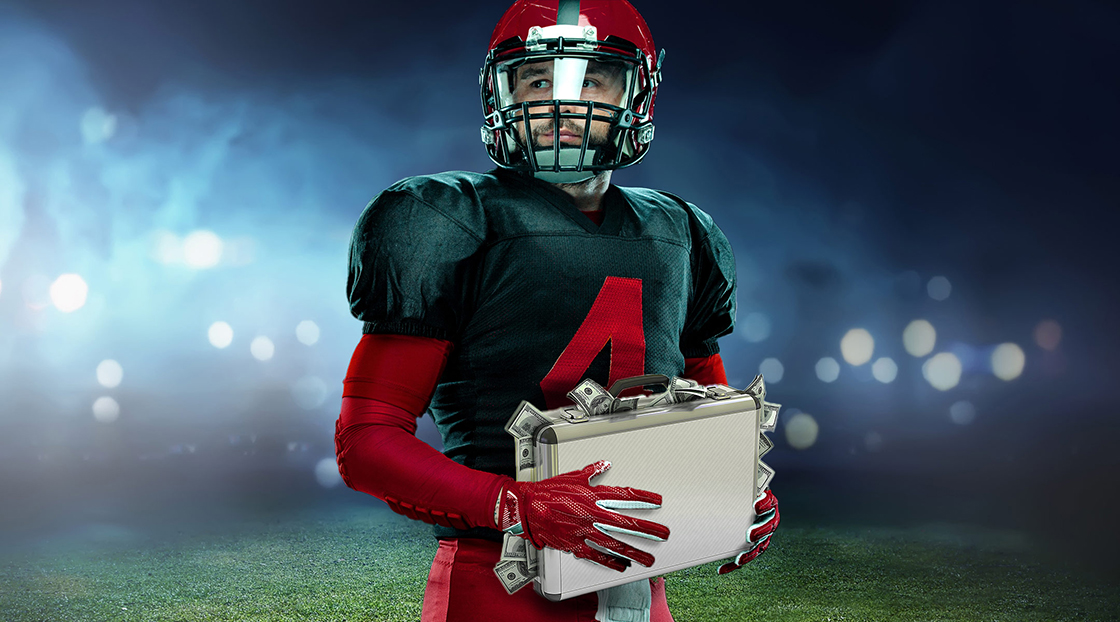
For four years, many major-sport student athletes at high-profile schools have enjoyed essentially blank checks from donors and third-party “collectives.” Those days might be over.
Since the NCAA in July 2021 began allowing college athletes to receive compensation for their Name, Image and Likeness, bidding wars for touted men’s football and basketball players have led to annual paydays worth nearly $7 million.
The unregulated landscape created a Wild West in which the rich essentially became richer with regards to big schools and top talent. Boosters from top-level programs began paying middle and high school students to secure their commitments years before they ever set foot on campus. If a powerhouse school missed out on a prized player during the recruiting cycle, or especially if a smaller-university athlete developed into a useful prospect, the powerhouse-school boosters could cut a big check to lure them in the NCAA transfer portal.
It was all legal through NIL, but in the past two months, a major court decision, an executive order from the White House and a ruling from NIL’s new governing commission have changed the game for good.
The New Era of NIL
“We’re entering an era of revenue sharing, which in my mind absolutely had to happen,” longtime ESPN college football analyst Kirk Herbstreit told Volt. “The hope now is that NIL is reigned into what it was intended to be.”
The June 6 decision from U.S. Judge Claudia Wilken of the Northern District of California set an annual cap for schools to pay athletes directly, starting at $20.5 million per school in 2025-26 and increasing every year for the next decade. That ‘revenue-sharing’ model adds to money that student-athletes can already receive through NIL, but Wilken’s ruling — known colloquially as the “House Settlement” for a plaintiff’s name — also significantly tampers down what’s fair game under NIL. It also adds a major financial burden to university athletic programs: paying players directly has already led a number of schools to cut staff, others to slash their budgets and a few to even cut various non-revenue sports.
College athletes can no longer just accept a blank check, Herbstreit explained, say $1 million for an autograph signing at a booster-owned car dealership that doesn’t come anywhere close to recouping the money for the dealership. Instead, they now have to submit every payment to an “NIL Go” clearinghouse run by the newly-formed College Sports Commission and accounting giant Deloitte. If the CSC and Deloitte determine the deal is fair market value — officially “commensurate with compensation paid to similarly situated individuals with comparable NIL value” — then the deal can proceed.
If not, and the athlete still accepts the money, they risk being suspended or losing their NCAA eligibility.
“It will be a step forward if it’s enforced correctly,” Herbstreit said. “What we’ve had over the past few years has given players all of the leverage over schools, and it’s hurt both the players and schools. It’s better when there’s a balance of power, and we just haven’t had that.”
Fair market value? Or still pay-for-play?
Andrew Zimbalist has taught in the economics department of Massachusetts-based Smith College since 1974 and served as president of the non-profit Drake Group from 2022 to 2024. Drake Group has operated for 20 years to “combat the influences of money in college athletics” and Zimbalist has been among its dozens of scholar-members calling on the U.S. Congress to rein in collectives’ influence.
When President Donald Trump issued a surprise executive order on July 24, calling to “save college sports” through monitoring the legitimacy of NIL, Zimbalist admitted to being “very pleased,” despite not agreeing with Trump on most other policies. Trump’s order aims to supersede various NIL laws in 30 U.S. states by explicitly banning pay-for-play. It also implores schools and boosters to spread revenue and NIL spending to the over 20 Olympic sports on campuses nationwide, instead of focusing exclusively on money-makers like football.
“The NIL payments can be real or they can be fake,” Zimbalist explained, citing the anecdotal $1 million autograph signing at a car dealership as an example of “subterfuge” to pay-for-play. “The guidelines set out in the House Settlement and the executive order I think are on the right path. In both cases, they’re trying to mute or tamp down pay-for-play, but to allow athletes to sell their name, image, and likeness in legitimate deals.”
Zimbalist said the jury’s still out on whether the CSC will actually enforce the new NIL rules correctly, but believes Trump’s executive order helps keep the pressure on. And though the executive order doesn’t lay out explicit terms—it instead assigns U.S education secretary Linda McMahon to develop them—Trump’s message aligns with the House Settlement on curtailing pay-for-play.
Unlike the House Settlement, though, the executive order addresses Olympic sports and essentially warns schools “we’re watching you.” That’s according to David Meluni, a Syracuse University scholar known nationally for his NIL-focused courses and research. Meluni largely agreed with Zimbalist’s assessment of the executive order.
“What Trump is essentially doing is saying, ‘listen, this pay-for-play with the millionaires and billionaires, I’m keeping an eye on this. We’re going to know what’s pay-for-play versus fair market value.’”
Meluni, whose Syracuse NIL classes include athletes from all 20 of the school’s varsity sports, said the new regulations won’t necessarily affect how much money top-dollar athletes, such as University of Texas quarterback Arch Manning, earn each year. Instead, the strategy for paying players and building competitive rosters simply changes. Instead of boosters and collectives writing massive NIL checks to top-earners like Manning, Texas — which still isn’t subject to fair market value rules — can now foot that bill with pieces of its $20.5 million revenue-sharing allotted for players.
Collectives will still spend their money, Meluni said, but just spread it out in ways that pass the NIL Go’s requirements for fair market value. That means $100,000 payments to 10 linemen instead of $1 million to a star running back.
“And if you look at it from a business standpoint, it makes more sense for the boosters, too, because you can get these 10 guys out to autograph signings and have them do ads for you, and you might get more attention from that than if you overpaid one star player to just do one thing.”
A big cost to universities, but also a big marketing opportunity
Allocating $20.5 million to pay players has pressured university athletic departments across the country, leading some to cut staff, others to slash their budgets and even some non-revenue sports at Division I schools being axed completely. That trend may continue as the salary cap jumps to an estimated $22 million starting in July 2026 and roughly $24 million in July 2027. But as athletic departments scramble to raise money, some see a chance to strike marketing gold.
While major college athletes have been starring for brands in national TV commercials and on social media for four years, they very rarely wore their universities’ insignias or mentioned their schools in the ads. Now, since universities can directly pay many of their biggest-name athletes via revenue-sharing, having them advertise explicitly for the school could be a game-changing marketing opportunity.
“If I’m a school paying you $2 million to be my quarterback, you’re going to be wearing your jersey on billboards, on social media, going to caravans, signing autographs and selling tickets for me,” Meluni said. “You’re going to do all of that. You’re going to be out and about, no question about it.”
Can it offset the exorbitant costs? In many cases, not quite. A top-tier blue-chip athlete in the most-followed major sports — like Manning or former Colorado quarterback Shadeur Sanders — is worth an average of some $750,000 to $2.5 million to their schools.
But in some cases, especially when teams achieve unexpected success, the marketing value of players would far exceed their cost. Butler University’s success in the 2010 and 2011 men’s basketball season led to an estimated $1.2 billion in publicity value and a 41% increase in student applications when the team reached the national championship game in both seasons. At Iowa, women’s basketball star Caitlin Clark similarly led the Hawkeyes to back-to-back appearances in the national championship game, in 2023 and 2024, earning the university north of $15 million in added revenue those two seasons.
Regardless, if the cost of fielding teams gets too high, Zimbalist believes it could lead to unintended consequences for college sports — especially football.
“I really think the financial pressure on them will eventually lead college teams into the arms of the NFL,” he predicted. “I could see the top 30 schools essentially functioning as minor league teams for the teams in their respective NFL markets.”
A unionized future, just not as employees
University athletes have pursued unionizing and collective bargaining in different forms for decades. But the Wild West of NIL has helped generate more buzz than ever around the idea as the college sports ecosystem scrambles to create guardrails. The House Settlement and executive mandate may take steps towards order, but both Herbstreit and Meluni believe some form of collective agreements are next up.
The caveat? If those collective agreements involved unionizing they could turn student-athletes into employees, which could legally turn college sports into professional leagues. That might not matter to star players whose futures lie in pro sports, but it could certainly impact the 98% of NCAA athletes who don’t go pro and who instead rely on their college education after graduating.
“You have to remember that being at school and getting a degree is really important for some of these guys,” Herbstreit said. “At the same time, we have to do away with the threat of litigation and anti-trust laws. It’s a delicate balance.”
Meluni sees collective bargaining starting with revenue-generating sports like football and basketball, over rules including practice time and lengths of contracts so that players can’t simply leave mid-season to transfer schools for the following year. With the House Settlement and executive order making significant splashes in recent months, though, both Herbstreit and Meluni say the next major NIL-related changes likely won’t happen until next year.
“I think everybody’s going to sit back at Division I and evaluate 2025-2026,” Meluni predicted. “That said, the longer you delay it, the longer people will try to backfill it with lawsuits. There’s a premium on time. If we’ve learned anything these past few years it’s that the landscape of college sports is moving very quickly.”