Students are approaching their college search differently in the generative search era. Zero click search is on the rise, with AI summaries and generative AI chatbots rapidly supplanting traditional search results. Consumers now complete 40% of their online searches without clicking any links, according to a survey of more than 1,000 people conducted by Bain in December. The decline in CTRs across industries is also negatively impacting higher ed.
How AI is Reshaping the College Journey
In this climate, traditional search is no longer the arbiter of excellence or answers. Generative engine optimization results are poised to reshape brand perceptions moving forward. A 2024 survey by Carnegie found that 70% of prospective college students had used AI, with 7% using it regularly. Many Carnegie survey respondents said they plan to use AI for their college search. Students are using AI to search more efficiently and to narrow down college choices based on their personal preferences.
One Carnegie survey respondent said, “AI is a more accessible and knowledgeable guidance counselor who isn’t always busy with other students.”
Read: Collegevine’s new AI tool shows the future of college admissions is already here.
As clicks and organic traffic decline across higher ed, ascertaining your institution’s visibility and brand sentiment is essential for maintaining a competitive edge. Both search engines and generative engines favor engaging, original content that is structured and well organized. Effective content aligns with user intent. Generative engines also favor schema and knowledge graphs. Utilizing structured data to organize your content and grouping semantically related terms will enhance generative engine content performance.
Establishing and maintaining thought leadership in a broad variety of content areas is essential for your brand’s web presence. Widely cited websites perform better in generative engine results. Ensure that your brand is discoverable, accurately represented, and recommended by generative AI systems. Also, endeavor to increase your brand’s citation frequency. AI favors brands with a high number of published academic articles.
What We’ve Learned from Adjusting Our Content Strategy at Kean University
At Kean, we recently updated our heading structure to utilize a question-and-answer format. This better aligns our content with current user behavior, as AI chatbot interactions are more query focused and conversational.
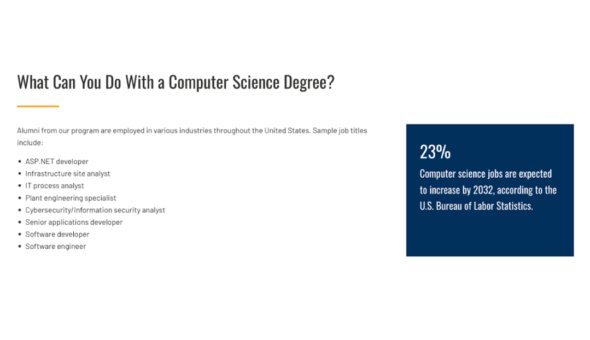
Kean.edu’s new headings feature common user queries like “What do you learn as a computer science major?” And “What can I do with a computer science degree? Our new academic program page structure has helped Kean outperform our closest competitors in mentions. We’re also leveraging faculty voices to help close the citation gap.
Encourage your faculty to publish research and reports as open access content on public platforms. Include white paper links, Google Scholar links and publication links on faculty profile pages. Outreach to print and digital media outlets can also help you gain traction in generative engine results.
High-quality backlinks from other reputable websites boost page authority and content performance. Employ traditional link building strategies like collaborating with government entities and other colleges to post your educational resources on their sites. Encourage your faculty to contribute podcasts and authoritative blogs. The more a website’s content is referenced across credible sources, the more likely it is that it will be included in generative engine search results.
ChatGPT does not provide information about specific user queries or brand mentions. Tracking individual user behavior within the platform is limited. Another limitation is the absence of API integrations specifically designed for tracking mentions and citations in ChatGPT. However, you can indirectly monitor your brand’s presence and impact related to ChatGPT using Google analytics and referral data.
A few brands claim to provide high-quality AI data analytics, gauging brand sentiment, mentions and citations.
- Otterly.AI measures brand sentiment within AI-generated answers for specific keywords you monitor.
- SpyFu’s Spy GPT feature allows you to see how often your brand is mentioned in ChatGPT queries.
- Brightedge’s AI Presence tool tracks AI mentions and citations.
- SEMRush also has a nascent AI analytics tool.
Any of the leading AEO analytics platforms will enable you to track mentions and citations and compare your performance with your closest competitors.
Don’t limit video content to your university’s YouTube channel. Feature video and podcast content on your academic program pages and on your research page, to create a high quality user experience and an immersive scroll. Internal linking is a traditional SEO strategy that also boosts AEO performance. Featuring your content across multiple channels creates a robust network of backlinks that LLMs favor. Multimedia content provides an enhanced user experience. Repurpose your news, video and audio content by featuring it in relevant areas across your website.
The Generative AI search experience highlights the differences between data and insight. While traditional search engines respond to queries with a list of links, generative engines create detailed narratives by synthesizing vast data sets into digestible summaries, highlighting key insights, making meaningful comparisons and providing highly curated recommendations.
Going Forward
AI assistants provide a high-value user experience that is eroding Google’s market share and deflating CTR’s across our industry. Translate data into actionable strategy by analyzing your site’s generative engine performance and aligning your website’s content with the seismic shift in user behavior that AI has precipitated. Bridging the gap between traditional search and AI technology requires investing in generative engine optimization and leveraging available tools to build brand authority.