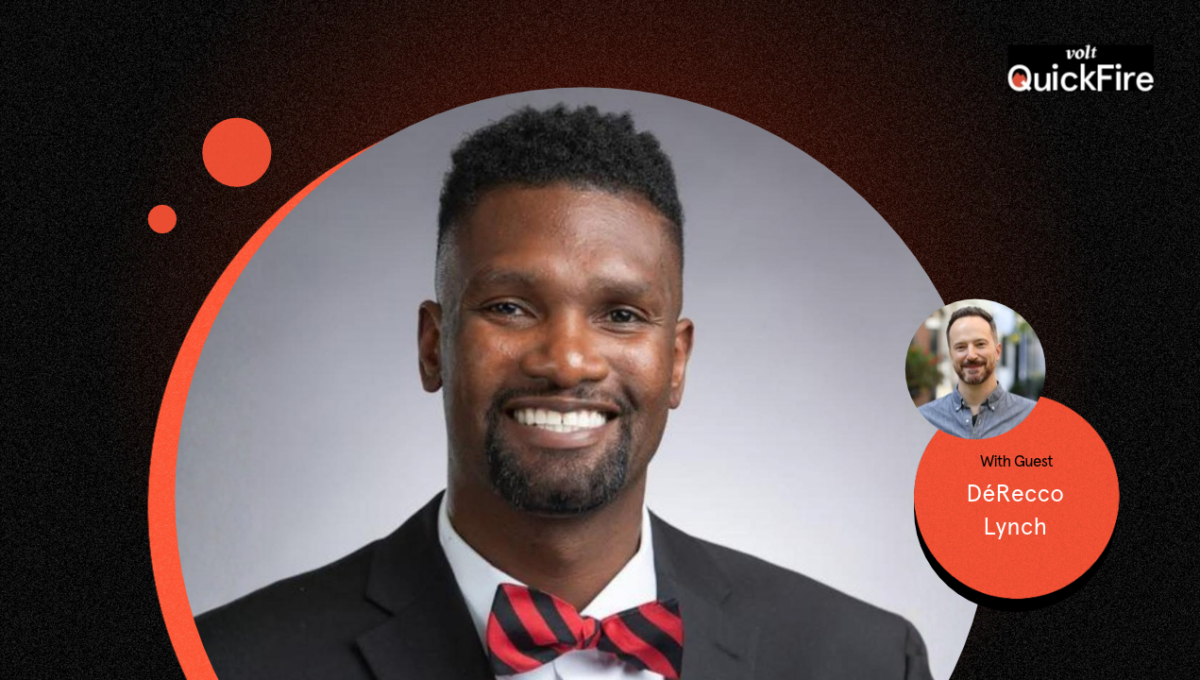
DéRecco Lynch has worked at Salesforce, Apple and Disney, and across HBCUs, Ivy League campuses and large public university systems — a résumé built for the question every higher ed marketing leader eventually asks: what should we actually borrow from corporate America, and what should we leave alone? Now Assistant Vice Provost for Enrollment Management at the University of Cincinnati, Lynch just helped land the university’s largest incoming class in history — not by chasing enrollment targets, but by rebuilding the enrollment team’s culture first. He also publishes “The Excellence Factory,” a newsletter and YouTube series on the relationships and unwritten rules that shape careers. We talked to him about the AI tool that got him a petition, the meetings he cut by 60%, and why relationships matter more in higher ed than they ever did at Salesforce.
You’ve talked about bringing “Beyoncé energy” into higher ed. What does that mean?
Beyoncé pulls from all different artists, all different types of culture, to build a body of work. From a higher ed perspective, how do we take what we’re learning from our Amazon experience, our Uber experience, all these different networks we engage with, and use it to make the student and staff experience better? That’s where people can pull in that energy — mining other experiences for what they can do on campus.
What can higher ed learn from corporate America, and vice versa?
Big tech is obsessed with the customer experience — they don’t build around the org chart, they design around what value they’re trying to deliver. Higher ed is moving that direction, but the student experience has always been treated as a byproduct. That’s what higher ed could learn from corporate. Corporate could learn to lean more into relationships. In higher ed, we build relationships with departments before we even introduce the work. In corporate, a lot of teams have a transactional relationship instead of a real one, and that creates barriers real relationships would move past faster.
What’s something you tried to import from Salesforce that didn’t work?
I built our own admissions AI agent from scratch — started at noon, finished at three, sent it to the team at 3:15. In big tech, when you build something and share it, the team runs with it. Here, I got a petition about anti-AI use. I had to slow it down and bring people into it. We created an AI council to govern it and introduce it to the division properly, but it did not land well with the team at first.
What’s a corporate move you had to shrink down to campus scale?
Corporate courts you as you’re interviewing — even if you don’t get the job, you leave with an affinity for the company. Higher ed doesn’t have the resources to build a whole talent team, so instead we created a talent task force: a group of people from different teams who handle all our hiring. Every interview is consistent, and onboarding actually incorporates people into our culture instead of just throwing them into the seat and saying “run.” It’s created a kind of boomerang effect, too — like Salesforce, where people leave and come back because the culture is better here than wherever they went.
Where do university hiring departments have room for improvement?
Higher ed treats hiring like an admin checkbox — we need somebody, put a search together, five months later maybe you’ve found one person. In big tech, they’re courting you the way you’re courting them from the moment you apply. I had over four months of intensive onboarding at Salesforce, then weekly enablement after that, so I understood the revenue goals and had the support to actually do the job. Higher ed needs a real talent strategy, not just a search process.
If a CMO told you they wanted to run their team “like a tech company,” what would you tell them to change first?
Get clarity on your revenue priorities and your big bets — period. Don’t have any other conversation until that’s settled. Then look at your budget, your people, and how they work together before you buy any tech, run any ads, or ask for any money. That’s where CMOs go wrong — everybody jumps to the campaign or the technology. If you slow down and understand what you’re actually trying to achieve, you probably already have what you need. And get financial excellence: understand your budget and your ROI before you ask for anything else.
What does the culture transformation at Cincinnati actually look like day to day?
When I got here, Central Admissions had about a 20% sense-of-belonging score. We’ve moved that to 90%. I came in saying I don’t care what the enrollment targets are — I care about having the number one place to work on campus. We cut our meetings by 60%. We built a playbook that spells out what makes you a culture blocker versus a high performer. Culture isn’t a poster or a tagline — it has to be built into your operations, not just pizza parties.
What’s a piece of institutional politics the corporate world didn’t prepare you for?
In corporate, people do their job whether they know you or not. In higher ed, if I don’t like you, I can slow something down and never be held accountable for it. You have to build relationships before there’s an ask — you have to influence people you don’t manage and aren’t held accountable for. That’s very different from the transactional way things move in corporate.
What’s the higher ed marketing version of “the invisible economy” — the unwritten rules that determine outcomes beyond credentials?
Credentials qualify you. Performance makes you credible. Relationships get you discussed. In higher ed, that shows up in task force committees and cross-departmental collaboration — that’s where the key players are and where decisions get made. I’d also argue the CMO role is shifting toward chief engagement officer. It’s no longer just about marketing to get people to come; it’s about creating a brand experience across staff, faculty, students and alumni.
What would you tell a marketing director trying to get noticed by leadership three levels up?
Don’t just join every committee — you won’t have time to produce your work. Put the same energy into your own narrative that you put into telling the institution’s story, and use the language each audience actually cares about. If I tell a provost we got 30,000 impressions, he doesn’t care. If I say we moved academic quality by 6% because a student could use the portal better, that number matters to him. Same project, same outcome, different audience. Think about your 60-day win and create the halo effect of a quick, visible result.
If you could steal one person from outside higher ed to fix one problem on campus, who and what?
Can I pick three? Amy Weaver, CEO of Direct Relief and former Salesforce CFO — she made 90,000 people understand what a billion dollars of revenue meant to them, and higher ed could use CFOs who walk the whole institution through its financial health. Jessica Ross, CFO at GitLab, for operational and financial transformation — building the machinery that actually supports revenue goals, not just reporting the numbers. And Christina Jones, CEO of Black Girls Code, who taught me that it’s not just about getting someone to do a thing — it’s about creating the kind of affinity where people fall in love with the work.
Higher ed doesn’t need bigger budgets to compete with corporate playbooks — it needs the discipline to know which parts of those playbooks to steal, and the humility to admit which ones already work better on campus.