
Higher education marcom titles can be messy. Very messy.
At one institution, a director may lead an entire marketing operation. At another, a director may oversee a single function within a much larger division. Some institutions use AVP titles liberally. Others skip them entirely. And “CMO” can mean anything from the institution’s chief strategic marketing officer to the person overseeing advertising and creative services.
So, a title itself only tells you so much.
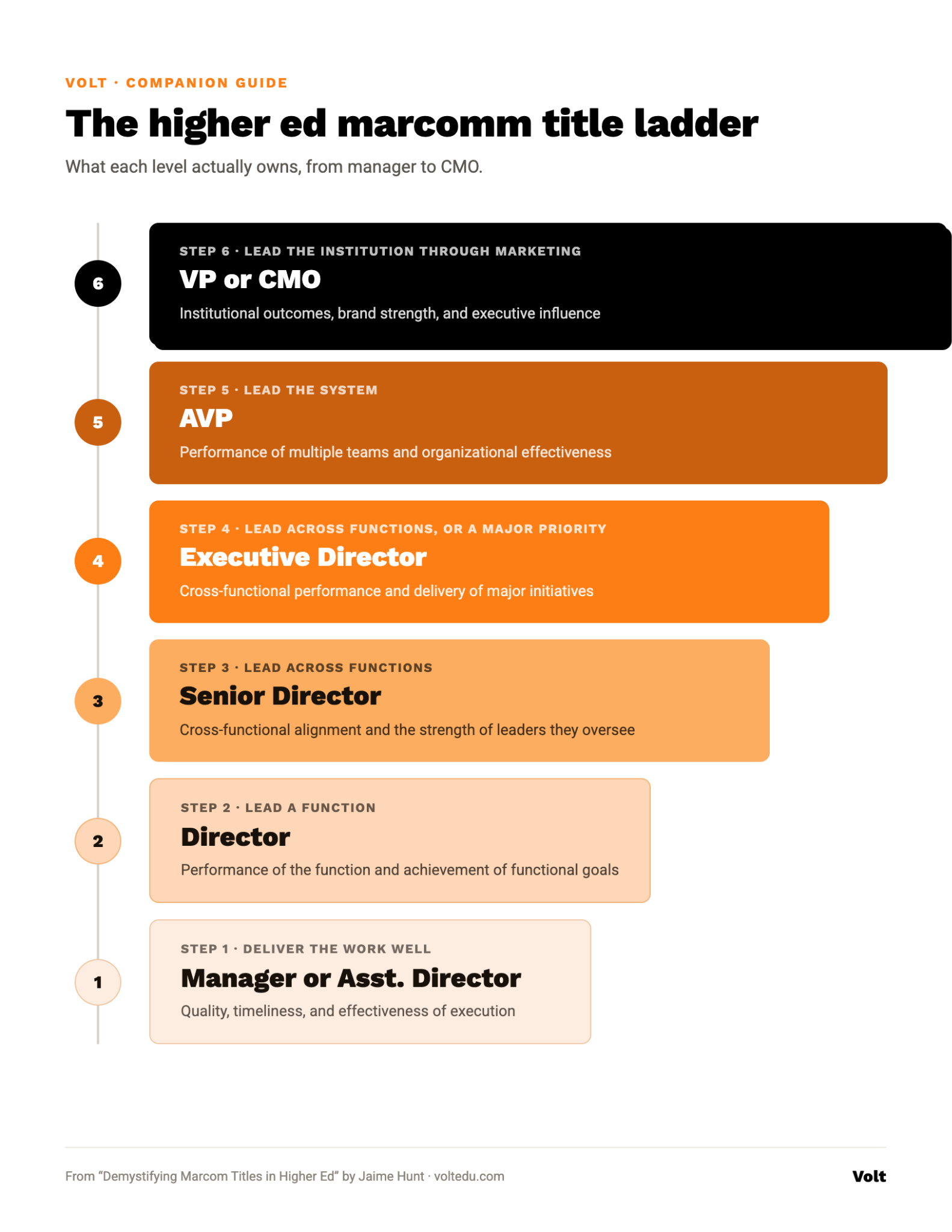
Creating clarity in titles and their associated job responsibilities can be enormously helpful. This guide is designed to help you as you think about the roles within your division. I hope it can also serve as a resource to help make a case for changing a title when it makes sense.
Title: Manager or Assistant Director
Level of Responsibility: Deliver the work well
Success Measure: Quality, timeliness, and effectiveness of execution; reliable ownership of projects and channels.
At this level, the primary responsibility is usually execution. A manager or assistant director should understand the institution’s strategy and translate it into strong work within a defined area. They may manage projects, vendors or a small team, but they are still relatively close to the work itself. Typical duties might include:
- Managing campaigns, projects, or channels
- Producing or overseeing high-quality deliverables
- Coordinating timelines and workflows
- Tracking performance and reporting results
- Supervising staff or vendors
- Identifying problems and proposing solutions
- Building expertise within a particular function
Title: Director
Level of Responsibility: Lead a function
Success Measure: Performance of the function; team effectiveness; achievement of functional goals; smart use of resources.
The director level is where the job should begin to shift substantially. A director title shouldn’t be given just because someone has years of experience doing the work. A director should be leading a function. That means establishing priorities, developing staff, improving processes and making decisions about how resources are used. Directors should understand how their area contributes to larger institutional goals and think beyond whether their own projects are getting completed.
A director of digital strategy, for example, should not just “manage” the website. They should be thinking about how the institution’s digital ecosystem supports recruitment, retention, revenue generation, reputation, and audience experience.
Typical expectations for a director might include:
- Setting strategy for a functional area
- Translating broader goals into plans and priorities
- Managing and developing a team
- Allocating budget and resources
- Establishing standards and processes
- Measuring effectiveness
- Partnering with peers across the marketing and communications organization
- Advising senior leaders within their area of expertise
Title: Senior Director
Level of Responsibility: Connecting the functions
Success Measures: Cross-functional alignment; success of major initiatives; ability to anticipate and resolve problems; strength of leaders they oversee.
The difference between a director and a senior director is often one of the least clearly defined distinctions in higher education. Ideally, a senior director has a broader lens. They may still own a particular discipline, but they should increasingly be able to see across teams, channels, and priorities. They should recognize when a problem that appears to be about social media is actually a brand problem, when a website challenge is really a governance problem or when an enrollment campaign issue requires coordination across various units both within and outside of the division. They should also require less direction from senior leadership.
Typical expectations include:
- Leading a complex or institutionally significant portfolio
- Connecting work across multiple functions
- Resolving competing priorities
- Coaching directors and managers
- Leading major cross-functional initiatives
- Anticipating organizational needs
- Making recommendations based on institutional rather than departmental interests
- Representing marketing and communications in broader conversations
Senior directors should begin moving away from being primarily functional experts and toward becoming organizational leaders.
Title: Executive Director
Level of Responsibility: Lead across functions or a major institutional priority
Success Measure: Cross-functional performance; successful delivery of major initiatives; alignment of people and resources; progress against broader strategic goals.
The executive director level typically represents a shift from leading a single function to leading across multiple functions, teams, or a significant institutional priority. An executive director should be able to see how different areas of the marketing and communications operation work together and create alignment among them. They are often responsible for translating broad strategy into coordinated action across teams while anticipating where priorities, resources, or processes may come into conflict.
For example, an executive director overseeing enrollment marketing might not directly manage every channel or campaign. Instead, they should be ensuring that content, creative, digital, web, and paid media are working together toward shared enrollment goals and that the work is aligned with institutional strategy.
Typical expectations for an executive director might include:
- Leading multiple functions, teams, or a significant strategic portfolio
- Translating institutional priorities into coordinated strategies and initiatives
- Creating alignment across teams and functional areas
- Leading major cross-functional projects
- Managing and developing directors or senior-level staff
- Allocating resources across competing priorities
- Identifying and resolving organizational or operational barriers
- Establishing shared goals, measures, and accountability
- Advising senior leadership on broader strategic opportunities and challenges
- Representing marketing and communications in institution-wide initiatives
Title: Assistant/Associate Vice President
Level of Responsibility: Lead the system
Success Measures: Performance of multiple teams; organizational effectiveness; resource optimization; progress against division-wide strategic priorities.
At the AVP level, the scope should widen again. An AVP is typically responsible for a collection of functions, teams or strategies. (And this is one role where an individual may move from an assistant VP title to an associate VP title based on experience.) They should be able to create alignment across areas that may have different priorities, workflows and cultures. This role often requires balancing strategy and operations. AVPs are close enough to the work to understand where systems are breaking down, but senior enough that they should not personally be solving every problem. Typical expectations include:
- Leading multiple functions or teams
- Developing integrated strategies
- Establishing organizational priorities
- Managing significant budgets and resources
- Building leadership capacity among directors
- Improving systems, structures, and workflows
- Navigating relationships with campus partners
- Translating executive priorities into actionable strategy
- Advising the VP or CMO on institutional opportunities and risks
Title: VP or CMO
Level of Responsibility: Lead the institution through marketing
Success Measures: Institutional outcomes; strength and distinctiveness of the brand; contribution to enrollment/reputation/revenue goals; executive influence; health and effectiveness of the overall marketing organization.
At the VP or CMO level, the job shifts from primarily managing marketing to helping lead the institution. The CMO should understand brand, enrollment marketing, communications, digital strategy, reputation, and audience behavior. But subject-matter expertise alone is not enough. A strong CMO should be able to sit at the executive table and contribute to conversations about enrollment, academic strategy, finance, student experience, philanthropy, reputation and organizational change. Their lens should expand well beyond, “How should we market this?”
Typical expectations include:
- Setting the institution’s overarching marketing and communications direction
- Advising the president and other executive leaders
- Connecting brand strategy to institutional strategy
- Making enterprise-level resource decisions
- Advocating for audience needs and market realities
- Building alignment across decentralized units
- Managing institutional reputation and risk
- Developing senior leaders
- Establishing accountability and performance expectations
- Deciding what the organization will not prioritize
- Helping institutional leaders understand the external environment
A Word About What Comes After the Title
Where titles really start to go sideways is when institutions try to cram the job description into the title. For example, “AVP for Marketing Strategy and Brand Management” or “Executive Director of Strategic Marketing Initiatives.” (I have been guilty of this in the past.) These titles often create more ambiguity, not less.
The more qualifiers you add, the less clear the actual authority of the role becomes. Take “AVP for Marketing Strategy and Brand Management.” Does this person own marketing or only marketing strategy? Are there other marketing leaders with overlapping authority? A simpler title like “AVP of Marketing” establishes both the level and the function. The position description can explain that the person owns strategy, brand, campaigns, etc.
Overly specific titles also create problems when responsibilities evolve. (I know a marketer who had four different variations of a title over four years. As duties were added to his job description, the title grew longer.) These lengthy titles also make external benchmarking harder and can unintentionally narrow authority. Going back to the “AVP for Marketing Strategy and Brand Management” example, that role can sound like an advisor to marketing rather than the person accountable for it.
That said, not all modifiers are bad. “Senior Director of Enrollment Marketing” or “AVP of Brand and Marketing” can be perfectly clear when those words define a genuine portfolio. The question is whether the language clarifies the scope or is being used to describe the entire job.
Titles Should Create Clarity, Not Confusion
At the end of the day, the goal isn’t to create a perfectly standardized hierarchy across all of higher education. That is probably impossible. The goal is to make sure a title accurately reflects the scope of the role, the level of responsibility and the expectations for leadership.
If you are designing an organization, ask whether someone’s title tells people roughly what they own and at what level they are expected to operate. If you are considering a promotion, don’t focus only on whether someone has earned a bigger title. Ask whether the role itself has actually expanded.
And keep in mind that the best title is the one that makes things clear, not the one that sounds the most impressive.