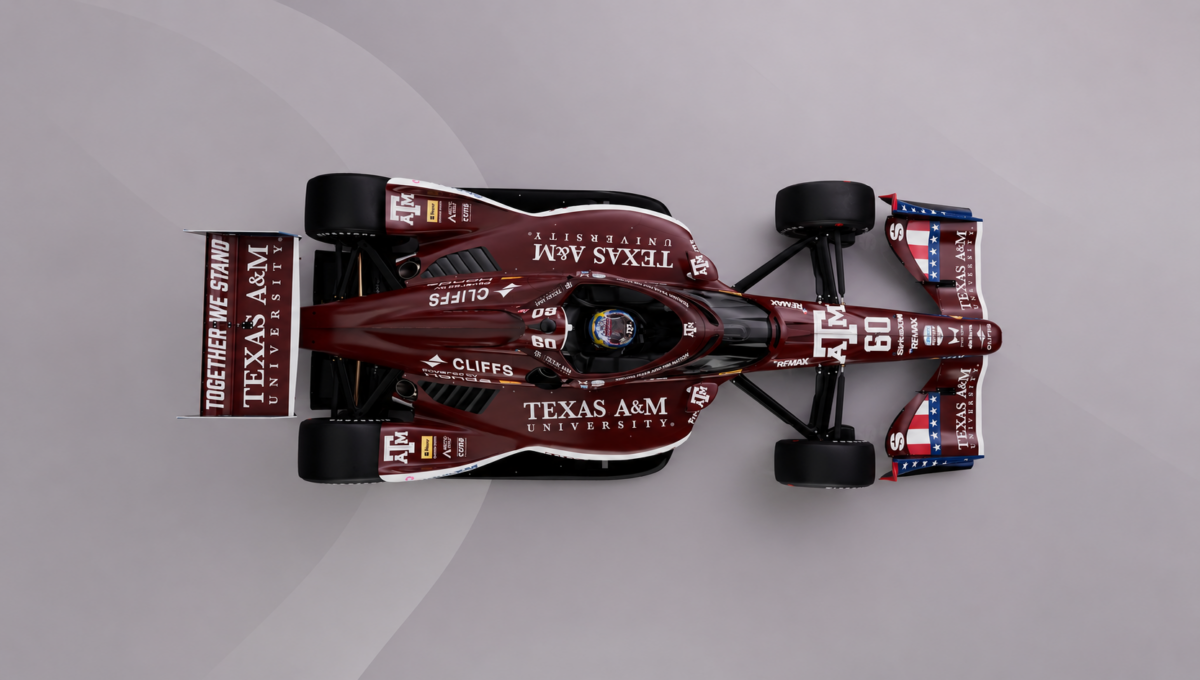
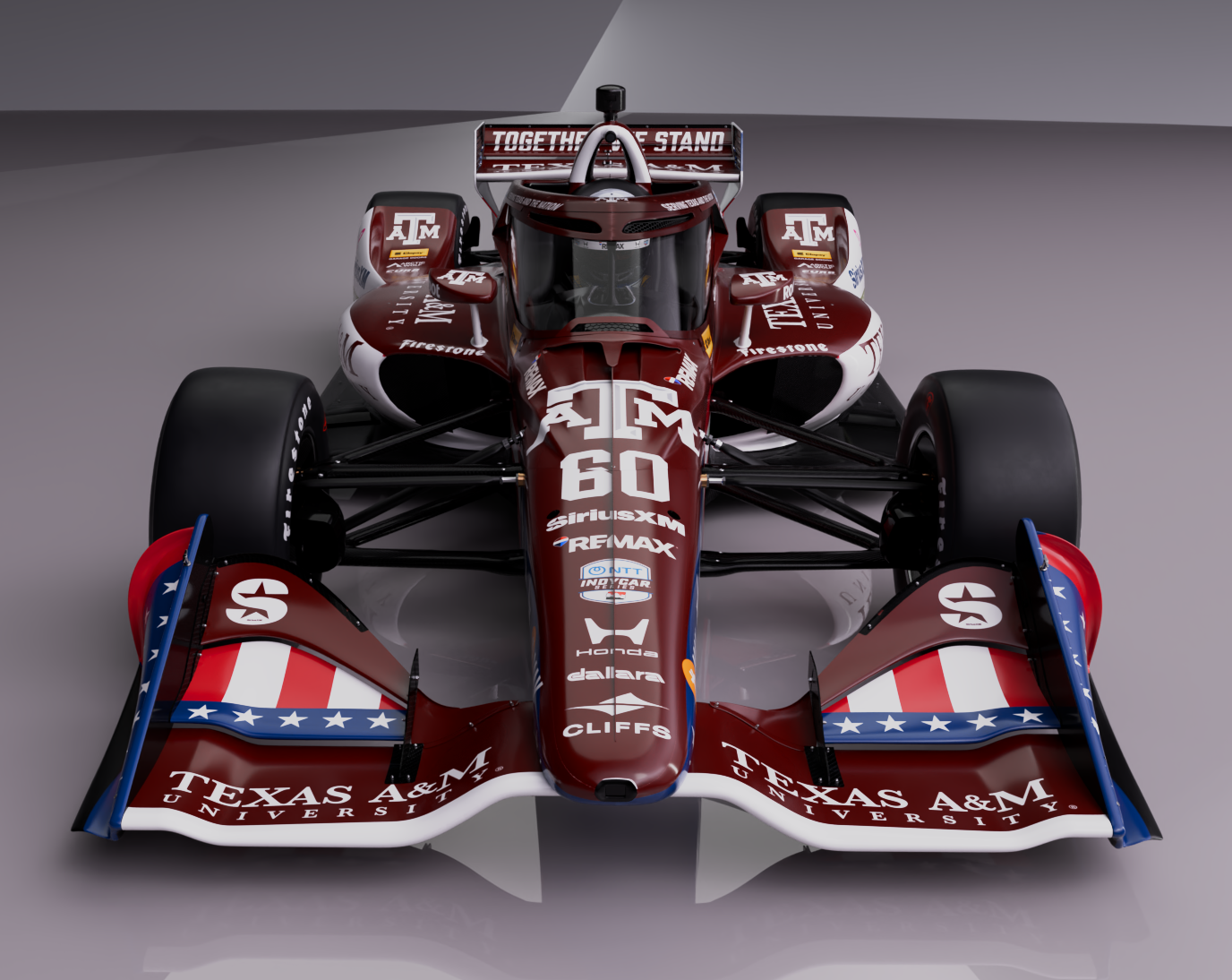
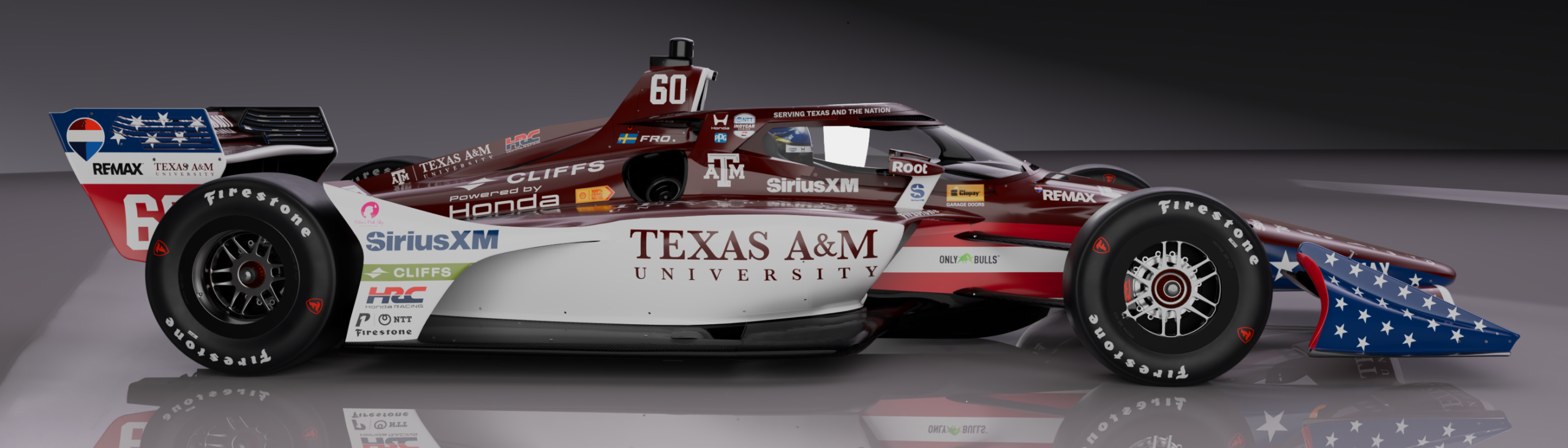
On Aug. 23, IndyCar driver Felix Rosenqvist, fresh off his Indianapolis 500 win, drove a Texas A&M-branded car through the inaugural Freedom 250 Grand Prix in Washington. The school served as the primary sponsor of Rosenqvist’s No. 60 Meyer Shank Racing Honda to amplify Texas A&M’s brand message of trust, service, and public purpose.
The race has drew a White House showcase and 288,000 ticket requests for roughly 100,000 seats. During the Fox broadcast, the university debuted a two-minute national commercial built around a new Lyle Lovett recording of Canned Heat’s “Let’s Work Together” (see the video below). Lovett is a Texas A&M alumnus, a Grammy winner, and a fellow at the university who works directly with students — the kind of detail that gives the film more than borrowed celebrity.
It’s a lot of moving parts for one campaign, and that’s the point. Ethan Braden, Texas A&M’s vice president and chief marketing and communications officer, built the strategy around stacking a live sporting event, a national broadcast, a celebrity artist, and an institutional milestone into one connected brand moment, then measuring what happens next. Before the checkered flag, we talked with him about how the idea came together, what it’s actually costing, how he’s tracking whether it worked, and what the rest of higher ed can realistically take from it.
Walk me through the brainstorming and decision-making process for this event. Who came up with the idea and how did it evolve?
We already had our eyes on the Freedom 250 as a motorsports opportunity, and at the same time we were developing the new institutional commercial we generally release around the beginning of the academic year and football season. The breakthrough was realizing how much more powerful those two things could be together.
Once we saw what Washington could become, we started thinking about it the way a great consumer brand would. How do you make the most of one big moment? How do the media, creative, talent, physical experience, earned story, social content, and live event all reinforce one another?
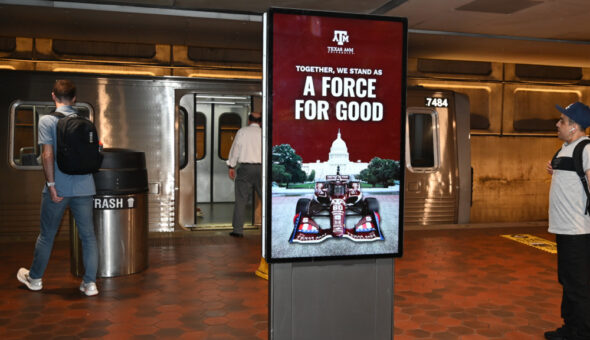
The ingredients were pretty extraordinary: an inaugural race in the nation’s capital during America’s 250th anniversary year, Texas A&M celebrating its 150th, Felix arriving as the Indianapolis 500 winner, Fox carrying the race nationally, a custom Texas A&M car, helmet, and fire suit, Lyle Lovett, and a two-minute anthem built around “Together, We Stand as a Force for Good.” Any one of those things could be interesting. Together, they become much more powerful.
Normally, we probably would have debuted the commercial around our first home football game, which this year would have been Texas A&M versus Missouri State two weeks later. Instead, we had the chance to introduce it to a larger national audience that knows less about Texas A&M and make the launch itself part of the story.
We wanted this to feel like a real national brand moment, more in the spirit of a Super Bowl launch or ‘Halftime in America’ than a traditional university commercial release.
That raised our ambition. We wanted this to feel like a real national brand moment, more in the spirit of a Super Bowl launch or “Halftime in America” than a traditional university commercial release. The two-minute anthem, the car, Felix, Lyle, Washington, the anniversaries, the broadcast, the earned media, and everything surrounding it became one integrated expression of the same idea.
Ultimately, it was about seeing a moment with unusual potential and trying to make absolutely everything we could out of it.
What’s the benefit of launching through sporting events over traditional methods we typically see in higher ed?
Live sports give you something that is increasingly hard for any marketer to find: a lot of people paying attention to the same thing at the same time. That is especially interesting in higher education because so much of our marketing naturally happens in places where people already have some reason to be thinking about colleges or universities.
The bigger opportunity is what you do with that attention.
I increasingly think marketing’s job is to make institutional value legible, not simply visible.
I increasingly think marketing’s job is to make institutional value legible, not simply visible. Texas A&M already has extraordinary scale in education, research, service, engineering, agriculture, health, national security, athletics, and the reach of the Aggie Network. The challenge is helping people understand what all of that adds up to and why it matters.
Live sports give us a stage. The insight and the creative execution have to turn that attention into memory, meaning, and understanding.
Was there a master plan to tie Texas A&M to motorsports, or did this build more organically?
It built over time, within a pretty clear strategic framework. We were looking for places where attention was high, Texas A&M had a credible reason to participate, and higher education was not already crowded together doing the same thing. Motorsports met that test because of the audiences and because it connects naturally to engineering, technology, safety, advanced manufacturing, teamwork, national security, and performance under pressure.
We first tested the category through NASCAR in 2024. In 2025, we expanded into IndyCar through our relationship with Felix Rosenqvist, including Texas A&M branding on his helmet throughout the season. The real strategic value at that point was the in-car camera. The placement gave us a very different media asset because the Texas A&M mark could sit directly in the viewer’s field of vision during onboard television and social footage.
In 2026, we took the next step. In Arlington, Texas A&M became the primary sponsor of Felix and Meyer Shank Racing, and we used the opportunity to tell a much more specific story: Texas A&M as a Force for Good in Texas. The car, helmet, fire suit, content, and surrounding experience all worked together around a reason for being there.
Then Indianapolis changed the scale of the relationship. We were not the primary sponsor, but Texas A&M was prominently represented on Felix’s helmet and fire suit and on the car. When he won the Indianapolis 500 in the closest finish in the race’s 110-year history, the in-car camera became enormously valuable. The final onboard sequence put Texas A&M directly into one of the defining sports moments of the year, and that footage kept traveling across broadcast, social, team, driver, and media channels.
We learned from that, too. This year, we moved Texas A&M more deliberately onto the front of the helmet as well so we can benefit not only from the in-car camera, but also from interviews, photography, pre-race coverage, victory celebrations, and the other settings Felix moves through during a race weekend.
San Diego sharpened the storytelling side even further. At the Navy 250 at Naval Base San Diego, Texas A&M was the primary NASCAR sponsor, and we built the car around President George H.W. Bush and his legacy of service. It connected the place, the Navy, national security, public service, and Texas A&M in a way that made the sponsorship feel particularly relevant. It also became the activation where we pushed our measurement much further.
Now Washington takes that progression another step. Arlington was Force for Good in Texas. San Diego was the Bush 41 car and a story rooted in service and national purpose. Washington is “Together, We Stand as a Force for Good” in the nation’s capital. We have gotten better at the media assets, better at the measurement, and better at the reason for being there.
That is also where optionality matters. You cannot plan for your driver to win the closest Indianapolis 500 in history. You can make disciplined choices that put you in position for extraordinary outcomes to matter when they happen.
What’s the actual budget for the sponsorship versus the commercial production versus the D.C. activations around it?
Washington is one of our largest motorsports sponsorships to date, and that reflects the scale of the opportunity. The attention around this race is unusual, a number of major brands are participating that are not typically in IndyCar, and advertising around the event is commanding much higher-than-normal rates. We are treating it accordingly.
The commercial is a separate institutional investment. It is a two-minute brand anthem that will also be cut into :60 and :30 versions for broadcast, and its 41 scenes give us an enormous amount to work with across social, digital, earned media, events, and other channels this year and beyond.
Then there are the surrounding D.C. activations, which extend the experience around the race. We will measure each component and, importantly, how much more valuable they become when they work together.
How do you measure success here? Applications, brand recall, media value, something else, and what number makes this a success?
Our framework is reach, recall, and relevance. Did enough of the right people see us? Did they remember Texas A&M? And did the experience help them understand something meaningful about the university?
Underneath that, we look at broadcast audience, branded visibility, earned media, video performance, social engagement, search, web traffic, sentiment, content distribution, and eventually broader brand measures like awareness, familiarity, favorability, and trust. Applications can benefit from a stronger brand over time, just as advancement, recruiting, partnerships, and reputation can, but I would not attribute an application decision to one race or one commercial.
San Diego was an important step forward for us because we measured it much more rigorously than we had in the past. Instead of simply reporting the television audience or gross impressions, we looked at deduplicated reach across broadcast, earned, social, and owned media and assessed how prominently Texas A&M actually appeared. That analysis showed roughly 7.7 million in deduplicated reach and an estimated 8-to-12-times return on our investment.
We will do the same kind of analysis for Washington and probably learn even more because the ecosystem is broader. We want to understand the race audience, the quality of the branded exposure, how the anthem performs, how the content travels, what earned media it generates, what people search for, what they engage with, and what associations they take away.
I also think about alpha in addition to ROI. ROI tells you whether you generated a return. Alpha asks whether you generated a better return than the alternatives available to you. That is really the management question: did this create more attention, memory, meaning, and brand value than another reasonable use of the same dollars?
How are you tracking brand lift? Are you conducting a full tracker study or using some other proxy?
We have an ongoing national brand tracker that measures awareness, familiarity, favorability, trust, and other indicators of how people perceive Texas A&M. That gives us the longer-term view.
Brand effects accumulate. Someone may see Texas A&M during the Freedom 250 and then encounter us through research, athletics, a national news story, a former student, or a piece of social content. The important thing is whether those encounters begin reinforcing one another.
If every exposure tells a completely different story, you can generate a lot of impressions without building much brand memory. When those experiences increasingly reinforce a common understanding of Texas A&M, that is where the brand starts to compound.
So, the activation analysis tells us whether Washington worked as an investment. The tracker tells us whether the larger portfolio is making Texas A&M better known, better understood, more trusted, and more relevant over time.
Most AVPs reading this don’t have A&M’s budget or a major sporting event to attach to. What’s a version of this that works at a tenth of the scale?
The most useful lesson is how we found the opportunity. Every institution has some combination of strengths, people, place, history, capabilities, or relationships that gives it permission to show up somewhere in a way that feels credible and distinctive.
The opportunity is to find where that institutional truth intersects with meaningful audience attention. For Texas A&M, motorsports has been one of those places because the audience is highly engaged and the environment connects authentically to parts of our story.
The broader principle is to look for places where your institution genuinely belongs, where the audience matters, and where you can contribute something distinctive enough to be remembered.
What’s the smallest, cheapest thing from this playbook that another institution could copy this year?
I would be careful about telling another institution what it should copy. One of the things I learned from Mitch Daniels is that what works in one place does not automatically transfer to another, and I do not know what another university is trying to achieve, what constraints it has, or what assets it has to work with.
What I do think is transferable is the discipline behind the choices. Start with the objective, understand the audience, look hard at where attention already exists, and ask whether your institution has a credible and distinctive reason to be there. Then compare that opportunity against the other ways you could pursue the same goal.
The lesson is not to copy motorsports, a helmet, or any particular tactic. It is to find opportunities where the fit is unusually strong, and the potential value is disproportionate to the other choices you could make.
That is where alpha is useful. ROI asks whether an investment produced a return. Alpha asks whether it outperformed the alternatives available to you. The lesson is not to copy motorsports, a helmet, or any particular tactic. It is to find opportunities where the fit is unusually strong, and the potential value is disproportionate to the other choices you could make.
Whose idea was the Lyle Lovett commercial, and how did you land on him versus other alumni?
I would not really describe it as a Lyle Lovett commercial. It is an anthem built around a piece of our essence: Together. Together is what makes a force for good a force.
That is also why the video is called “Working Together for the Good of the Nation.” In many ways, that is the clearest expression of what we are trying to do in Washington. We wanted to take “Together, We Stand as a Force for Good” and make it emotionally real in a way that felt worthy of Texas A&M’s 150th anniversary, America’s 250th, and the setting in the nation’s capital.
We wanted an anthem. An agency partner surfaced Canned Heat’s “Let’s Work Together,” and the lyrics immediately connected to the heart of the platform. From there, we began imagining how the song could be reinterpreted to feel emotional, distinctive, and unmistakably Texas A&M.
That is where Lyle became central to the idea. We started with the message and the song, and Lyle gave both a voice that is uniquely credible for Texas A&M and recognizable far beyond our existing audiences. He brought the artistry, restraint, warmth, and emotional character that made the anthem what it is. His interpretation helps define the feeling of the entire piece.
The film moves through 41 scenes of service, research, teamwork, character, tradition, discovery, and people accomplishing things together. Lyle provides the connective tissue. His voice carries the idea from scene to scene and helps turn all of those proof points into something cohesive, human, and memorable.
It is also a useful brand-building lesson. Distinctive assets are not limited to logos and colors. They can be a sound, a song, a person, a phrase, or a visual language. Lyle and this interpretation of “Let’s Work Together” give the work a recognizable emotional signature in service to the larger idea: people working together for the good of the nation.
How much creative control did Meyer Shank Racing and Penske Entertainment have over how A&M’s brand appeared? Where did you have to compromise?
Penske? Zero.
Meyer Shank Racing has been terrific to work with. There are obviously technical specifications, safety requirements, existing commercial partners, and practical realities that come with a race car, fire suit, and helmet, and MSR has been very collaborative in helping us make the idea as strong as possible within those parameters.
We wanted the Washington car to be a bold, patriotic Aggie expression, something unmistakably Texas A&M that also felt worthy of the nation’s capital and America’s 250th. MSR understood that ambition immediately and has been excellent about helping us bring it to life. “Together We Stand” faces forward on the rear wing, while “A Force for Good” is visible to the drivers behind Felix. The design itself is carrying the message.
We also learned in San Diego that the livery reveal can be an event in its own right. There is real intrigue around seeing the car for the first time, and the reveal creates content, conversation, earned media, and anticipation before anyone takes the green flag. So, we think about how the car looks at speed, certainly, and also how it photographs, how it is revealed, how fans react to it, and how far the design can travel afterward.
I think former students are going to be extremely proud when they see this one. It is bold, distinctive, patriotic, and very Aggie. And I suspect the calls for die-cast versions are going to be immense. That is a pretty good sign that the design has become something people want to identify with, not simply sponsorship inventory.
Motorsports and the military/public-service framing are a specific bet. Are there target A&M audiences this does not land with, and are you okay with that?
Sure. Strong brands attract and repel. I do not think every expression of Texas A&M needs to resonate equally with every person.
Strong brands attract and repel. I do not think every expression of Texas A&M needs to resonate equally with every person
What I continue to believe is that there is a very large population outside Texas that can be genuinely enchanted by what Texas A&M stands for once they encounter it in the right way. The ambition is not really about motorsports. It is about fandom, engagement, and bringing the Texas A&M story to people who have not yet had a reason to embrace it. We want more people to understand this institution’s scale, character, service ethos, and its aspiration to be the best university for the world.
Motorsports is one unusually effective way to reach those audiences because it gives us attention, emotion, and cultural relevance in an environment where higher education is not typically competing. Military service is also central to Texas A&M’s history, identity, and sense of purpose. The Corps of Cadets, our service to the nation, and generations of Aggies who have worn the uniform are fundamental parts of what shaped this institution.
Our idea of service also reaches across the university, through agriculture, engineering, health, education, national security, disaster response, and countless other ways Aggies contribute. That breadth is why “Together, We Stand as a Force for Good” works for us. It honors a deep tradition of service and gives us room to show how that same ethic comes to life today.
There will also be people who do not immediately understand the marketing logic or the alpha value of pursuing opportunities like this. That is on us. We have to keep telling the story, showing the math, measuring rigorously, and explaining why an investment that produces disproportionate attention, memory, and brand value can be a smart use of resources.
Ultimately, the point is not to make everyone a motorsports fan. It is to expand Texas A&M’s reach, earn attention, build awareness and recall, deepen understanding, strengthen trust and relevance, and ultimately create greater demand among people who may not know us well today.
Do you see motorsports as a permanent channel for A&M, or is this era tied to the 150th/America’s 250th moment and it winds down after?
Motorsports has earned a meaningful place in our portfolio because it has performed. It has given us national reach, distinctive content, strong earned-media opportunities, student experiences, relationships, and moments that would have been very difficult to manufacture through conventional media alone.
Like every channel, it has to keep earning its place. We will continue to look at performance, strategic fit, audience, and comparative value. If motorsports continues to outperform other uses of those dollars, it should remain part of the mix. If something else offers greater strategic value, we should be willing to move.
What’s the next “high-attention national moment” you’re already eyeing?
We have exciting things ahead. We are increasingly building a strategic presence around moments where influential audiences are already gathering and paying attention, and where Texas A&M has a real reason to be there.
The fun part is finding the opportunities where we can do something people do not expect from a university, bring the full brand to life, and create something bigger than an ad placement. We want to earn attention, spark curiosity, build understanding and trust, and leave people wanting more Texas A&M.
There are a few things ahead that I am really excited about.
Editor’s note: Feature image by Meyer Shank Racing.